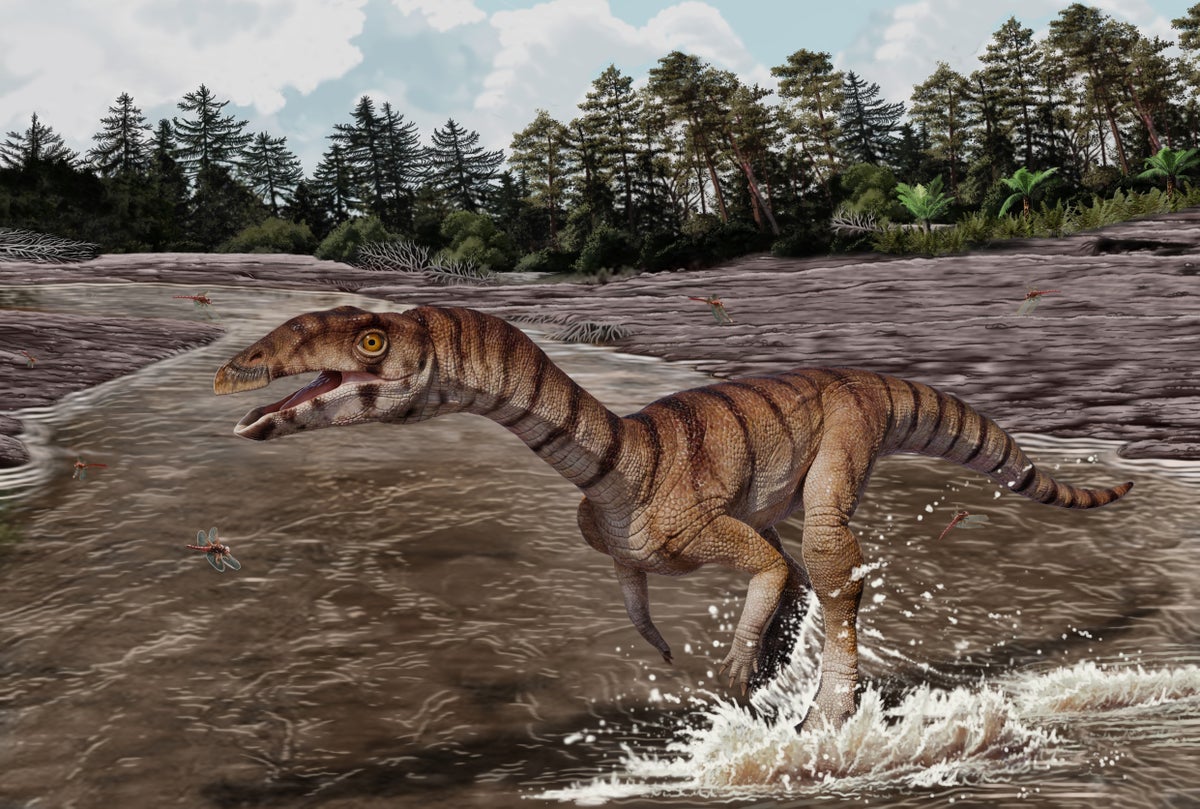
More than 200 million years ago, a beaked, toothless, bipedal reptile with tiny arms lived in what is now New Mexico. Fossils were found in a Triassic quarry in 2006 and resemble known North American shuvosaurids, a group of Late Triassic bipedal reptiles. The new specimen, Labrujasuchus expectatus, differs slightly from two recognized North American species. The bones date to about 212 million years ago, placing the specimen later than one species and earlier than another. Subtle anatomical differences, including features of the humerus, support recognition of a distinct species and help clarify evolutionary relationships within the crocodile-related lineage.
"More than 200 million years ago a bizarre, beaked, toothless reptile with tiny arms stomped around on its hind legs in what's now New Mexico. It may not have looked like it, but this newly identified creature was an ancient relative of a group of modern-day animals with a fearsome reputationcrocodiles."
"The bones closely resemble those belonging to the two recognized North American species of Shuvosauridae, a clade of ancient bipedal reptiles that lived through the Late Triassic. But the new Shuvosauridae specimen appeared just slightly different, says Alan Turner, a professor of anatomical sciences at Stony Brook University and leader of the team that discovered the remains."
"First, the bones were dated to around 212 million years ago, which was more recent than one of the North American Shuvosauridae species and later than other. And there were subtle physiological differences, such as in its humerus. Turner and his colleagues outlined the findings in a study in Journal of Vertebrate Paleontology."
"We look at those fine details, because those are the things that the evolutionary processes are shaping, and that lets us get at their family tree that way, he says."
Read at www.scientificamerican.com
Unable to calculate read time
Collection
[
|
...
]