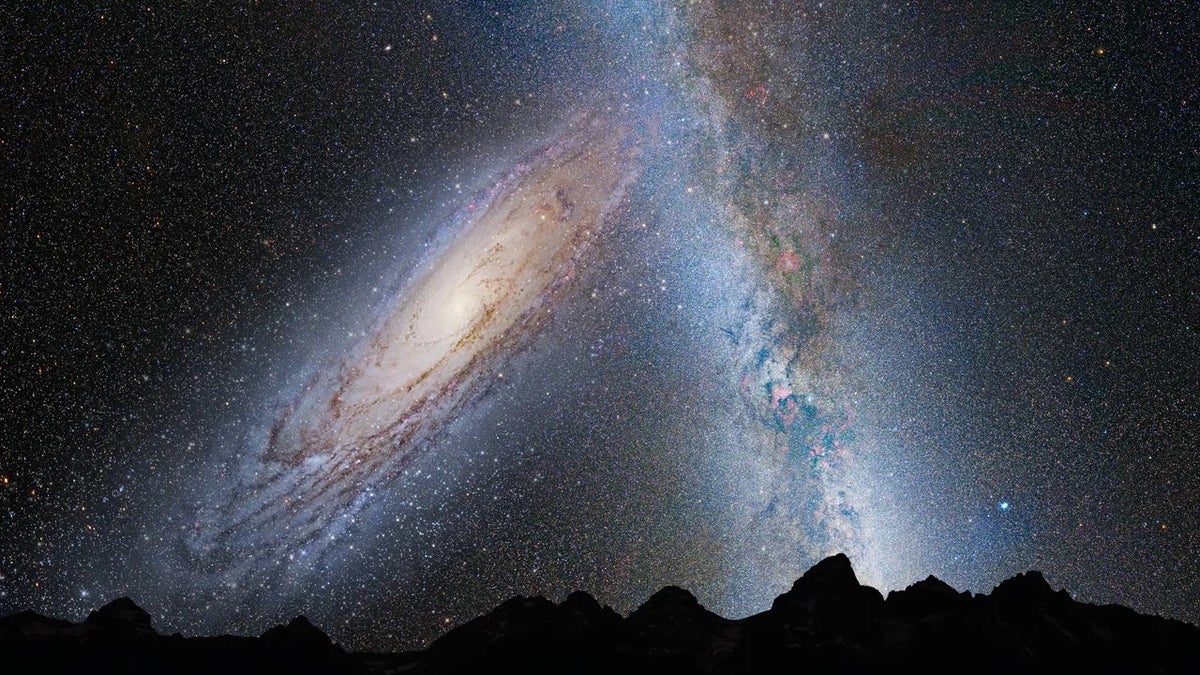
Andromeda’s approach toward the Milky Way was once estimated to lead to a collision in about four billion years based on Hubble Space Telescope motion measurements. Later studies produced different outcomes, including a miss or a collision occurring much later. New research accounts for gravitational influences from several satellite galaxies and finds collision odds are essentially a coin toss. Even if a collision occurs, it would not be an immediate disaster. The galaxies would crash at roughly a million kilometers per hour, and their large stellar disks mean the interaction would take hundreds of millions of years to unfold. The merged system would continue to show effects for billions of years afterward.
"In 2012 scientists published their results of Hubble Space Telescope observations examining the motion of Andromeda, the closest large spiral galaxy to our own. They found that, within the observational uncertainties at the time, Andromeda was essentially heading straight for us and would collide with our galaxy in approximately four billion years. Subsequent studies have cast doubt on this supposedly inevitable smashup. Some showed a clean miss, and others showed a collision after much more time."
"The latest research, which includes the trajectory-tweaking gravitational effects of several satellite galaxies, indicates the odds of a collision are 5050a coin toss. In a purely pragmatic sense, you shouldn't lose sleep over an impending collision with Andromeda because this new study suggests it won't happen (if at all) for another eight billion years or so. But assuming it does occur all those eons in the future, would residents of either galaxy have anything to worry about?"
"A Milky WayAndromeda collision would see these two titans crashing together at roughly a million kilometers per hour. That's incredibly fast on human scales but much less so on a cosmic one. The Milky Way and Andromeda each boast a flattened stellar disk well more than 100,000 light-years, or a quintillion kilometers, across, so a million-kilometer-per-hour collision can take hundreds of millions of years to unfold. And even then, the aftermath will still resonate within the newly merged galaxy for billions of years to come."
Read at www.scientificamerican.com
Unable to calculate read time
Collection
[
|
...
]