"A meteoroid-a small body moving through space-is called a meteor when it encounters a planet's atmosphere and subsequently produces a bright streak of light. This occurs because the meteoroid is traveling many times faster than the speed of sound."
"The 'boom' was not due to breaking the sound barrier, like a supersonic aircraft, but rather to the hypersonic meteoroid generating a powerful shockwave as it moved through the atmosphere. This shockwave compresses the air, producing a series of sonic booms or even a rumbling sound."
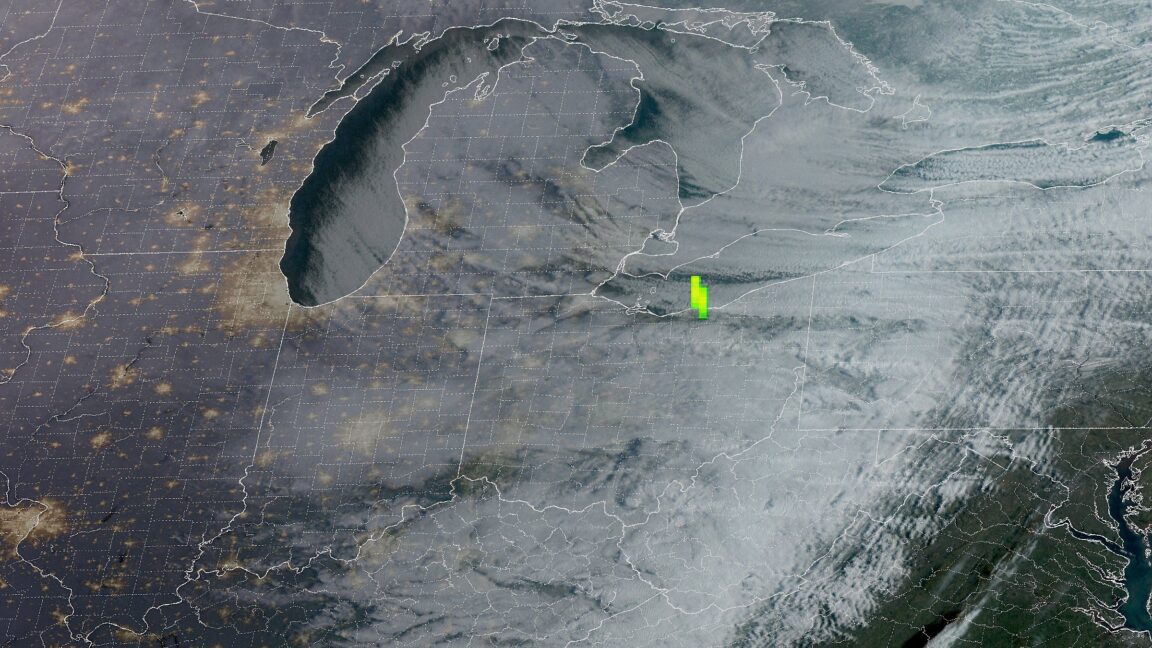
"The precise location of the fireball was pinpointed by a near-infrared optical detector on a geostationary satellite at 9:01 am ET (13:01 UTC). This 'geostationary lightning mapper' revealed that the meteor traversed through the atmosphere in northern Ohio, just west of Cleveland, and over Lake Erie."
A meteor passed through the atmosphere above northern Ohio on Tuesday morning, creating a visible fireball and producing an extremely loud boom heard by local residents. The bright streak was visible across a wide area, with video captured by a National Weather Service meteorologist in Pennsylvania. A geostationary satellite's near-infrared optical detector pinpointed the fireball at 9:01 am ET, locating it west of Cleveland over Lake Erie. The loud sound resulted from the hypersonic meteoroid generating a powerful shockwave as it compressed air through the atmosphere, rather than from breaking the sound barrier. No ground impacts were reported.
Read at Ars Technica
Unable to calculate read time
Collection
[
|
...
]