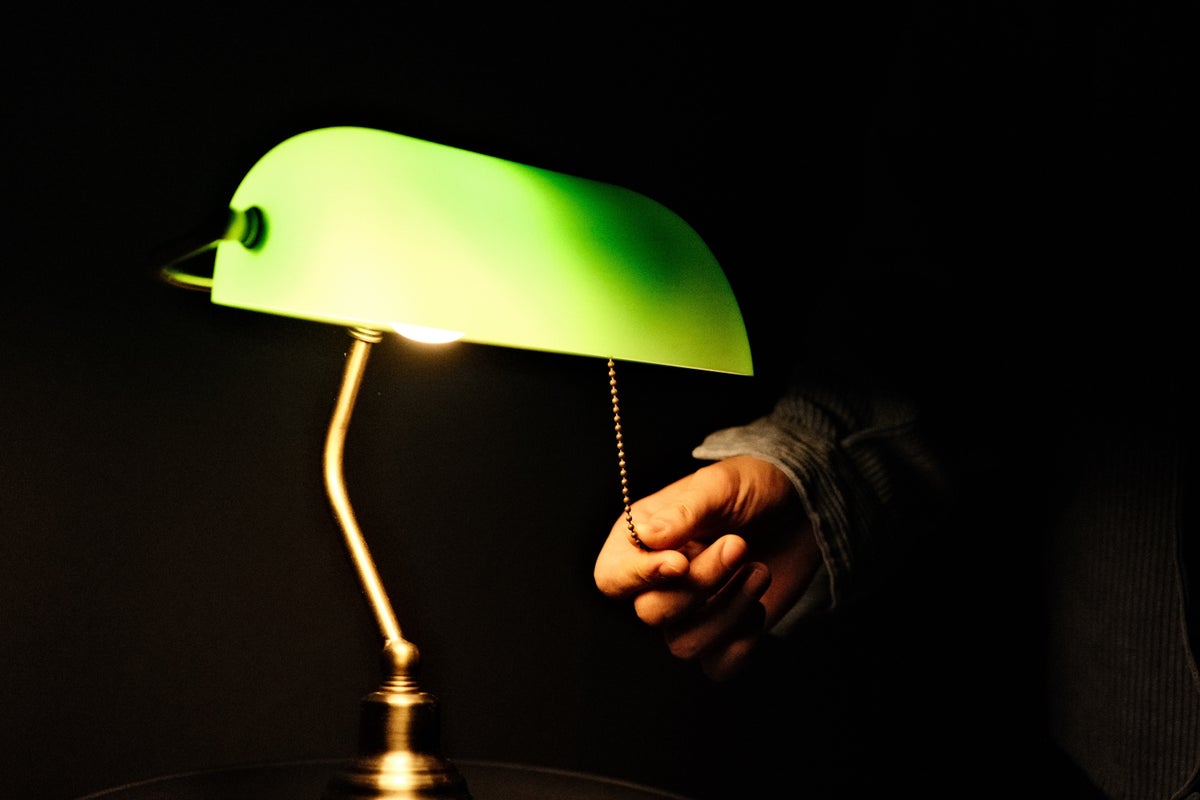
A lamp is turned on, then off after one minute, then on after 30 seconds, then off after 15 seconds, and so on, with each interval halved. After two minutes, the intervals approach zero, raising the question of whether the lamp is on or off at that time. A philosopher described the situation as impossible to resolve: the lamp cannot be on because it was never left on without immediately being turned off, and it cannot be off because it was turned on and never turned off without immediately being turned on. The lamp must be either on or off, creating a contradiction. Earlier versions connect the setup to infinite series where partial sums stay below a finite limit.
"You turn a lamp on, then off a minute later, then back on again after 30 seconds, then off after 15 seconds, and so on. Each time you flip the switch, you halve the time intervals so that the lamp turns on or off faster and faster. After two minutes, will the lightbulb be on? This supposedly simple question has produced heated discussion. In principle, the time intervals become smaller and smaller until they amount to zero after two minutes."
"It seems impossible to answer this question. It cannot be on, because I did not ever turn it on without at once turning it off. It cannot be off, because I did in the first place turn it on, and thereafter I never turned it off without at once turning it on. But the lamp must be either on or off. This is a contradiction."
"In principle, versions of this puzzle date back to 1703, when Italian scholar Guido Grandi was concerned with infinite series. These denote sums with infinitely many additions, such as: 1 + 1/2 + 1/4 + 1/8 + ... No matter how many terms you add in this series, the result is always less than 2. Mathematicians therefore say the limit of the series is 2."
#mathematical-paradox #infinite-series #thought-experiments #continuity-and-limits #switching-dynamics
Read at www.scientificamerican.com
Unable to calculate read time
Collection
[
|
...
]