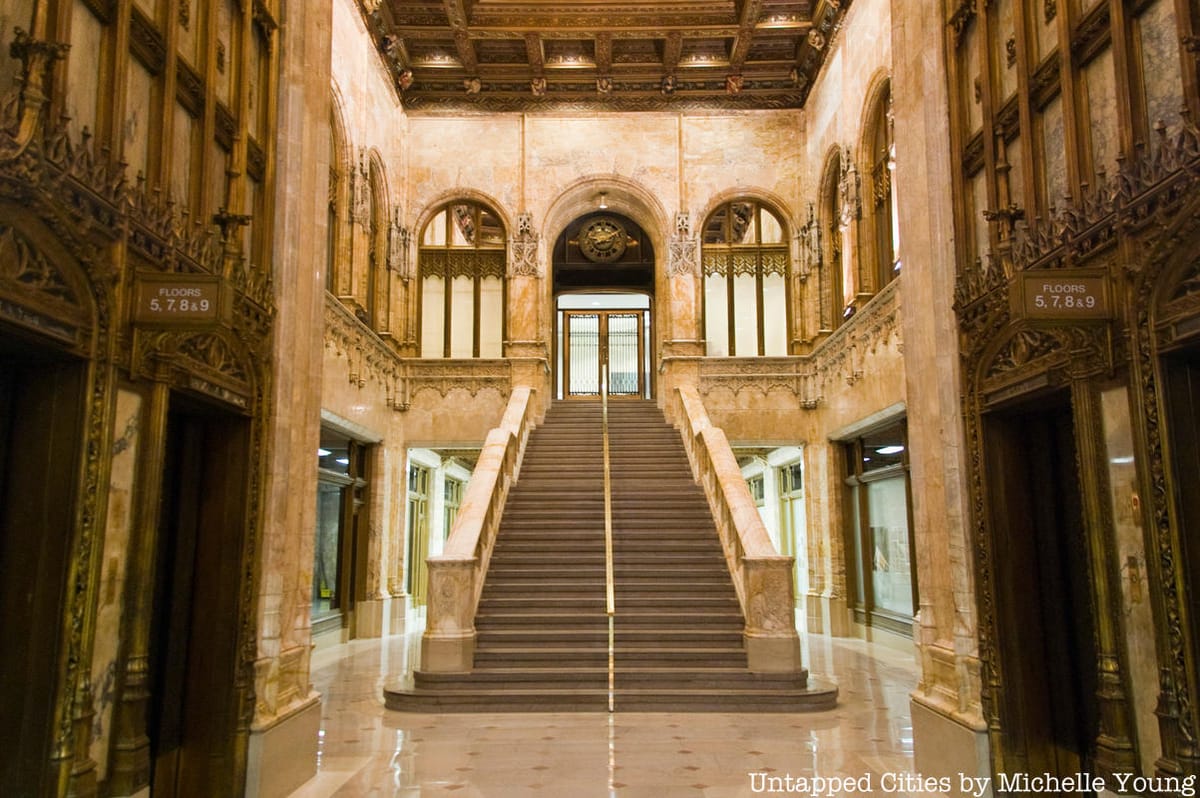
"When the Woolworth Building was constructed in 1910, owner Frank Woolworth and architect Cass Gilbert wanted to make the structure fireproof. With the recent tragedy of the Triangle Shirtwaist Fire and the memory of the Great Fire of New York City in 1835 in mind, every precaution was taken to ensure that the "Cathedral of Commerce" would not succumb to a similar fate."
"The Woolworth Building is one of the first skyscrapers to be constructed with steel. For further fire protection, the steel beams that make up the building's skeleton are wrapped in terra cotta, a clay that does not burn. Terra cotta was also used by Gilbert in his design of the nearby building at 90 West Street."
"90 West was severely damaged and caught fire in the terrorist attacks of 9/11, but due to the terra cotta, the spread of the fires was contained, and though chunks were missing and the inside had to be gutted, the building was structurally sound."
The Woolworth Building, constructed in 1910, was designed with extensive fireproofing measures in response to major fire tragedies like the Triangle Shirtwaist Fire and the Great Fire of 1835. Owner Frank Woolworth and architect Cass Gilbert implemented innovative fire protection strategies throughout the structure. Steel beams were wrapped in terra cotta, a non-flammable clay material, while limestone was used in exterior lower levels. These materials proved effective during the 9/11 attacks when nearby 90 West Street, also designed by Gilbert with terra cotta protection, contained fire damage despite severe destruction. The building's construction avoided flammable materials entirely, creating automatic fireproofing throughout the structure.
#fireproofing-architecture #woolworth-building #fire-safety-materials #nyc-landmarks #terra-cotta-construction
Read at Untapped New York
Unable to calculate read time
Collection
[
|
...
]