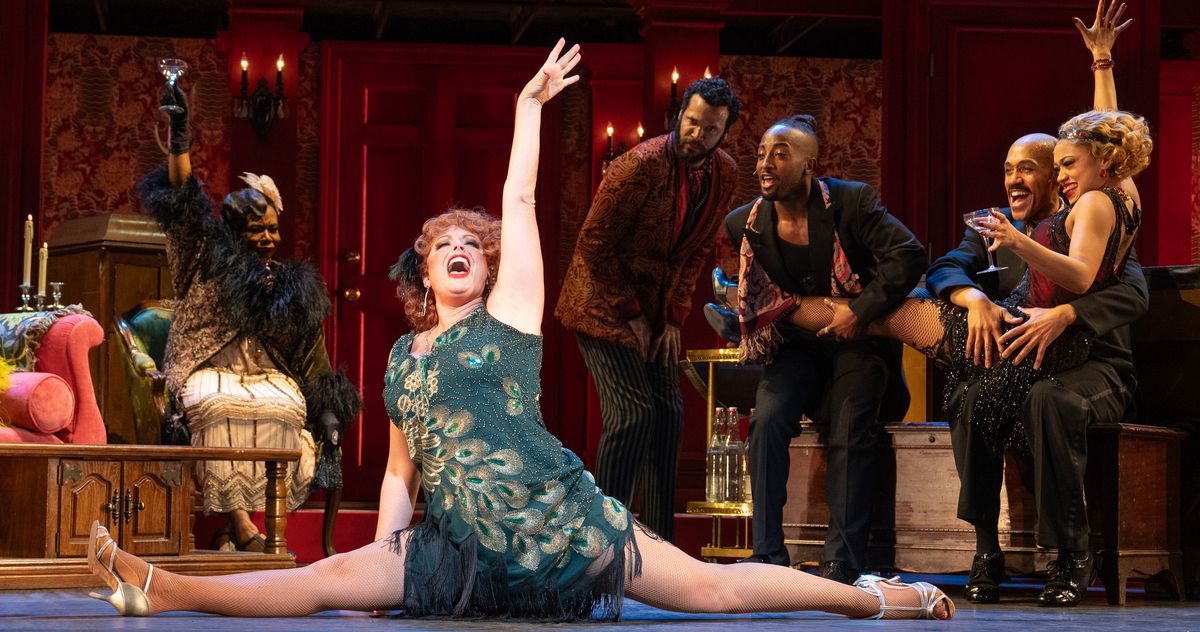
The Wild Party, a musical adaptation of Joseph Moncure March's 1928 poem, depicts a salacious party where guests constantly perform false identities. Characters include a fading performer pretending to be a star, a past-prime actress feigning bankability, and Jewish producers adopting WASPy names. The central figures are Queenie, the party's host, and her abusive lover Burrs, with Queenie passing as white while Burrs profits from performing Blackness. George C. Wolfe's 2000 Broadway adaptation, revived by Encores! under director Lili-Anne Brown, originally starred Toni Collette as Queenie and Mandy Patinkin as Burrs. Wolfe's approach connected Burrs's minstrel performance to his violence against Queenie, culminating in blackface imagery. The production reflects 1920s New York's fluid social hierarchies and the corrosive effects of racial performance.
"At Queenie's salacious parties, most everyone pretends to be someone else. A fading chorine still imagines herself a star. On the other side of the room, a stage actress past her prime pretends to be bankable. A bright-eyed teenager fudges a few more years into her age. Jewish producers trim down their last names to seem WASPy."
"In Wolfe's adaptation, the on-the-rise film star Toni Collette played Queenie (and if you watch the recording of her performance, in which she moves like a slinky, haunted marionette, you'll understand why cliques of fans have spent decades longing for her to come back to musical theater). Burr, written as a minstrel vaudevillian, was played by Mandy Patinkin."
"Wolfe's approach, smoky and troubling, linked that performance's corrosive effect on Burrs's soul to his violence against his lover, with Patinkin returning, late in the show, to a minstrel act, with white gloves and black face paint, as he lashes out against Queenie late in the night."
Read at Vulture
Unable to calculate read time
Collection
[
|
...
]