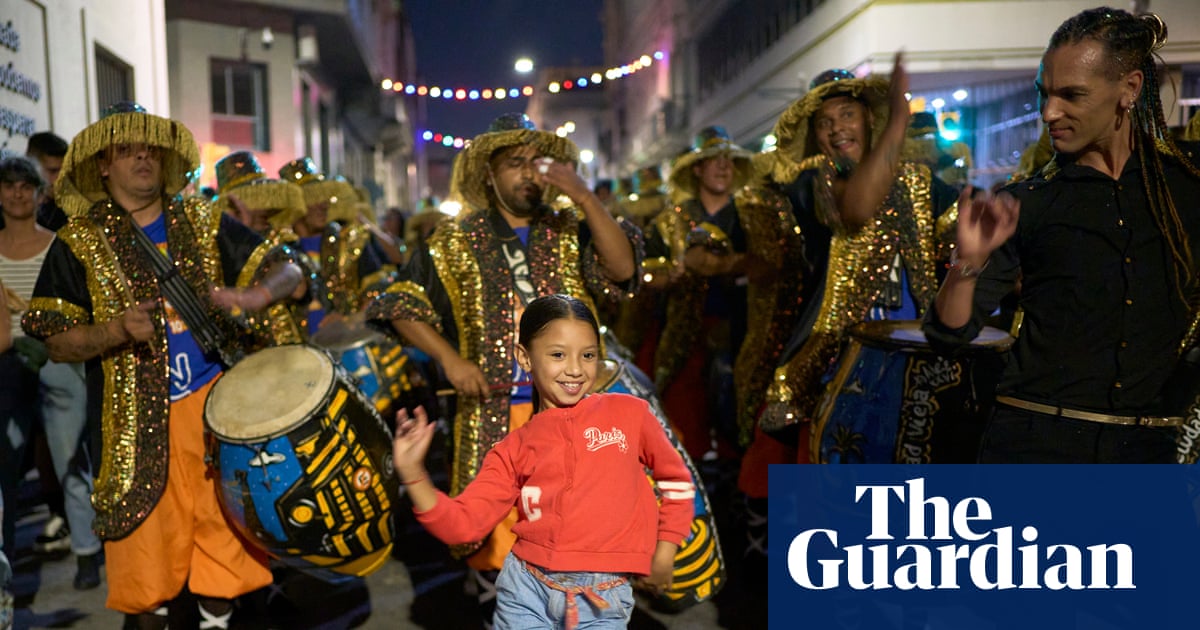
"Once confined to the Black neighbourhoods of the capital, Montevideo, candombe groups have spread to every region of the South American country of 3.5 million people, 10% of whom identify as Afro-Uruguayan. One Montevideo group, Rueda de Candombe, has been drawing up to 2,000 people every Monday to listen to a repertory that is entirely national and rooted in the Afro-Uruguayan rhythm."
"In the 18th and 19th centuries, it was only in the secrecy of homes or at a handful of authorised parades that Africans and their descendants were able to play their drums. One way to escape complaints from neighbours was to practise just outside the city wall – very close to where Rueda de Candombe now performs."
"Like the blues in the US, samba in Brazil, rumba in Cuba and plena in Puerto Rico, candombe, Uruguay's Afro-descendent music, was once reviled, marginalised and even banned but managed to endure. But while other such genres have for decades formed part of the cultural mainstream across the Americas, only now is candombe experiencing its peak."
Candombe, Uruguay's Afro-descendant music genre, historically faced suppression and marginalization similar to blues, samba, rumba, and plena in other American countries. Unlike these genres which achieved mainstream status decades ago, candombe is only now reaching its cultural peak. Originally confined to Black neighborhoods in Montevideo, candombe groups have expanded to all regions of Uruguay, a country of 3.5 million people with 10% identifying as Afro-Uruguayan. The Rueda de Candombe group draws up to 2,000 people weekly to performances featuring entirely national, Afro-Uruguayan rhythmic repertory. The genre's resurgence represents a significant turning point for this historically suppressed musical tradition.
#candombe-music #afro-uruguayan-culture #cultural-revival #montevideo-music-scene #historical-marginalization
Read at www.theguardian.com
Unable to calculate read time
Collection
[
|
...
]