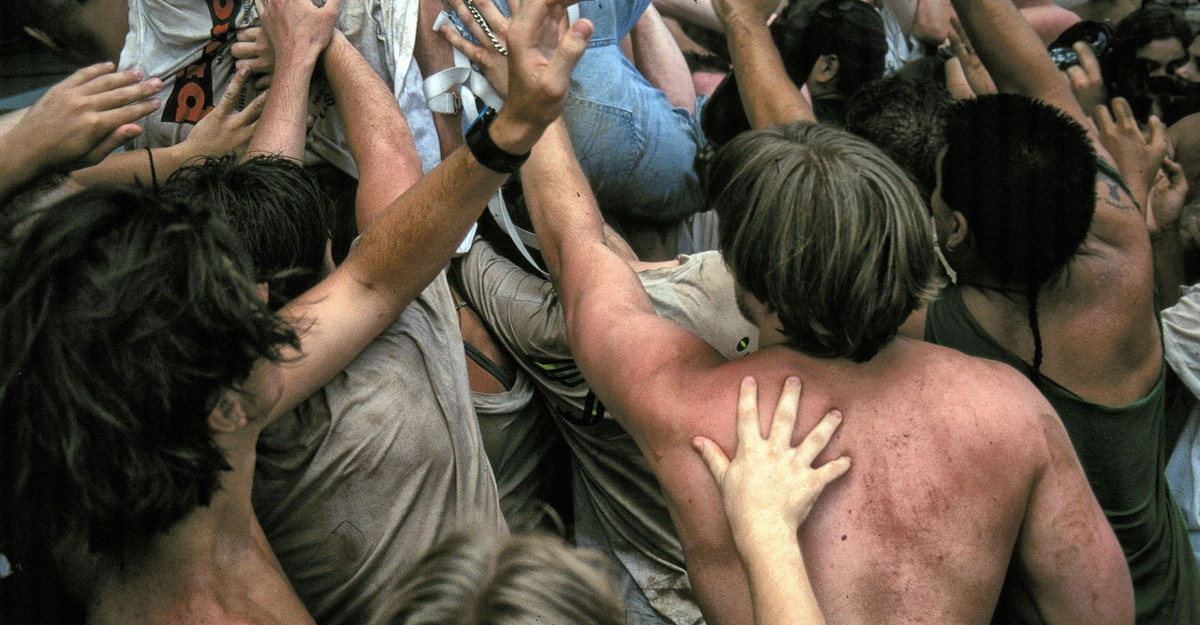
"He is balefully slash lovingly surveying the crowd and finding it a little sluggish and closely packed for his taste. "I need all my primitive, low-IQ motherfuckers!" Behind him, his band, Kublai Khan TX, rears and slumps into its next song. And the crowd lurches; the crowd flexes; the crowd feels its core, which is both a sucking emptiness and a site of repellent energy, like the space cleared by a fistfight."
"Hot autumn night has fallen over Worcester, Massachusetts, over the huge, baked asphalt lot behind the Palladium, the ancestral seat of the Northeast's heavy-metal kingdom. This is the New England Metal and Hardcore Festival, 25 bands on three stages, 10 unbroken hours of heavy music, and all day, I've been watching the pit-the mosh pit, the area close to the stage where inflamed dancers whirl and collide."
A muscular frontman pushes a packed crowd into a violent, cathartic mosh pit where bodies collide and a charged, ritualized energy forms. The New England Metal and Hardcore Festival at the Palladium stages sustained heavy music and concentrated physical release across dozens of bands and long hours. Observers circle the pit and note its combination of repellent energy and communal choreography. Heavy metal frames societal ailments—depression, addiction, technological alienation—and channels them into monstrous, gleeful expression. The pit functions as a contested space of raw expression, negotiated safety, and collective belonging that suggests practices for surviving shared life in 2025.
Read at The Atlantic
Unable to calculate read time
Collection
[
|
...
]