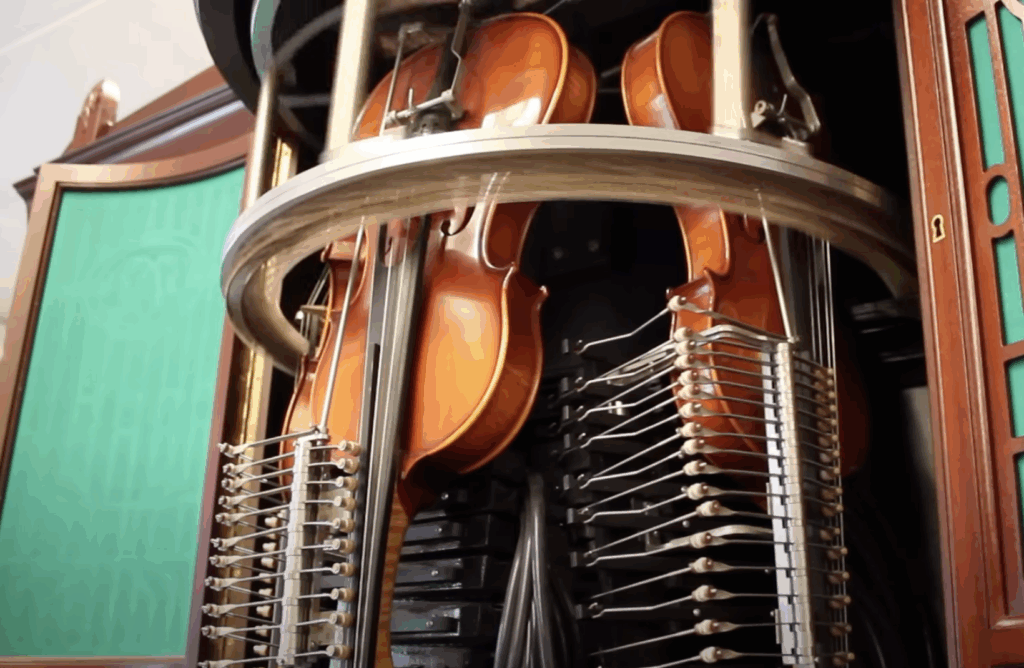
Ludwig Hupfeld unveiled the Phonoliszt-Violina at the 1910 World's Exhibition in Brussels. The instrument was once dubbed "the eighth wonder of the world." Hupfeld was a leading maker of automated instruments in Germany and produced phonola push-up players and player pianos. The Phonoliszt-Violina, created in 1907, featured three vertically mounted violins each with a single active string played by a rotating bow of 1,300 horsehairs. Pneumatic bellows pressed strings according to perforated rolls, and a player piano could accompany the violins. Upright home and commercial models entertained patrons in upscale hotels, restaurants, and cafes before gradually fading into obsolescence.
"At the 1910 World's Exhi­bi­tion in Brus­sels, Lud­wig Hupfeld unveiled the Phono­liszt-Vio­li­na, an instru­ment once dubbed "the eighth won­der of the world." A lead­ing mak­er of auto­mat­ed instru­ments in Ger­many, Hupfeld built a com­pa­ny that pro­duced every­thing from phono­la push-up play­ers to play­er pianos. In 1907 he cre­at­ed his most famous inven­tion, the Phono­liszt-Vio­li­na. It fea­tured three ver­ti­cal­ly mount­ed vio­lins, each with a sin­gle active string, played by a rotat­ing bow of 1,300 horse­hairs."
"Mean­while, pneu­mat­ic bel­lows pressed the strings accord­ing to per­fo­rat­ed rolls. And a play­er piano could accom­pa­ny the vio­lins. Sold in upright home and com­mer­cial mod­els, the Phono­liszt-Vio­li­na enter­tained patrons of upscale hotels, restau­rants, and cafes, before grad­u­al­ly fad­ing into obso­les­cence. The Win­ter­gatan video above, along with the Wel­teMax video below, will give you a nice intro­duc­tion to one of the most com­plex music play­ers ever made."
Read at Open Culture
Unable to calculate read time
Collection
[
|
...
]