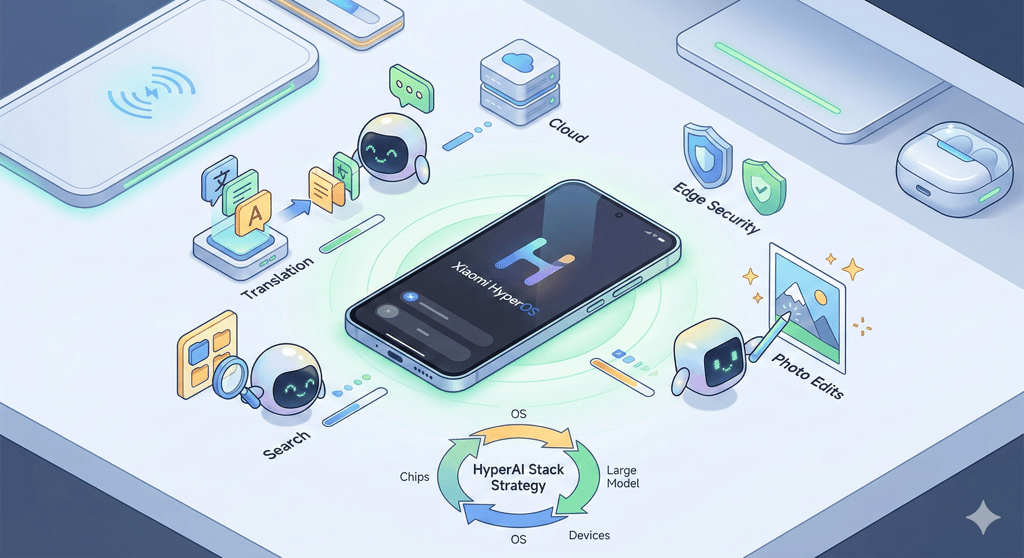
"Smartphone AI is moving away from flashy demos and toward the things people do every day: writing tools, translation, search, photo edits, and system shortcuts. The companies that win this phase won't necessarily have the most talkative assistant. They'll have the most consistent integration."
"In practice, OS-level AI tends to show up as small, repeatable assists: rewriting a paragraph in an email draft, translating text on-screen without switching apps, summarizing a long message thread, extracting dates and locations into a calendar entry, or turning a screenshot into editable text. Those are not 'voice assistant' moments - they're workflow moments, and they live inside the OS."
"Xiaomi also leans heavily on privacy framing in its public messaging. Its HyperOS materials emphasize 'edge-to-cloud AI data security,' including on-device privacy storage and secure transmission. That does not mean every AI feature runs entirely on-device, and Xiaomi does not claim that it does."
Smartphone AI is shifting from impressive demonstrations toward practical integration into daily workflows. Companies winning this phase prioritize consistent OS-level integration over sophisticated assistants. Xiaomi's HyperOS embeds AI as a system layer rather than a standalone feature, focusing on friction reduction in routine actions like email rewriting, on-screen translation, message summarization, and text extraction. These workflow moments occur within the operating system itself. Xiaomi emphasizes privacy through edge-to-cloud data security, on-device storage, and secure transmission, though not all features run entirely locally. This strategy reflects Xiaomi's broader effort to control more of its technology stack and differentiate through practical AI implementation.
Read at TechRepublic
Unable to calculate read time
Collection
[
|
...
]