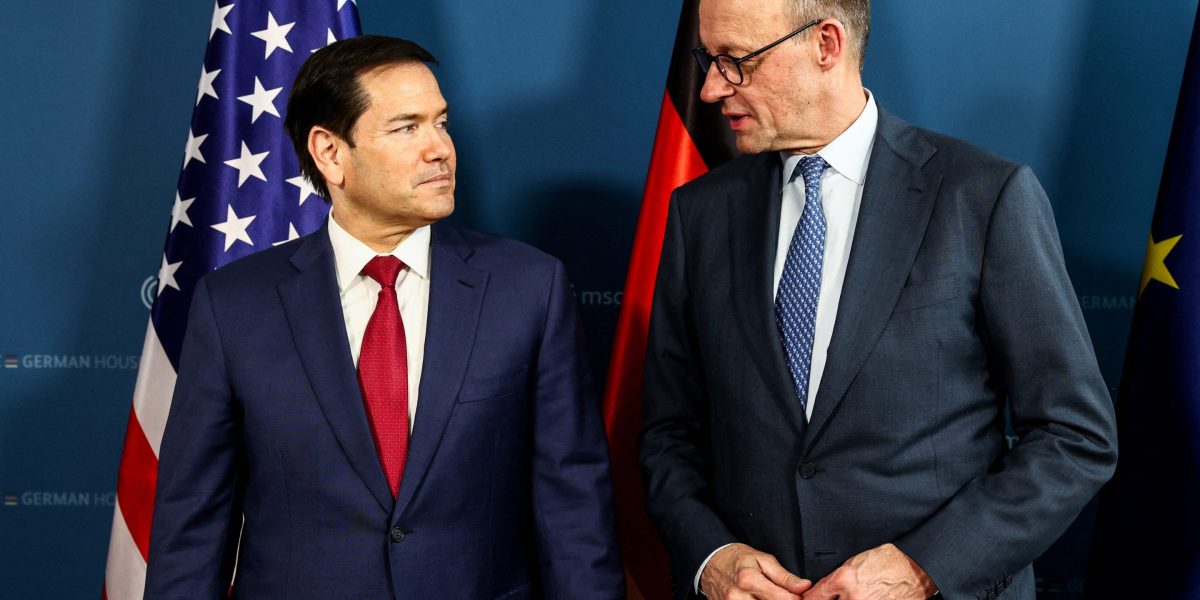
"Despite fears the trans-Atlantic alliance would break up over President Donald Trump's desire to take over Greenland, the U.S. and Europe are too intertwined militarily and economically to split, according to Dan Alamariu, chief geopolitical strategist at Alpine Macro. Indeed, U.S. geopolitical dominance actually depends on European allies, he said in a note earlier this month, even as NATO members scramble to boost military spending to shore up capability gaps. Meanwhile, Europe can't pivot to China or Russia."
""The plausible and likely path is messy coexistence: periodic trade clashes, louder rhetoric, and gradual European autonomy at the margins, alongside continued alignment on Russia, nuclear deterrence, intelligence, and China policy," Alamariu wrote. The strained ties were on display over the weekend during the Munich Security Conference. Secretary of State Marco Rubio vowed to remain involved in Europe and pointed to shared sacrifices on the battlefield, but reaffirmed the Trump administration's goal to reshape the alliance."
"Rubio also pulled out of a high-level meeting on Ukraine at the last minute, prompting one European official to call the move " insane " amid efforts to end Russia's war there. But for now, Europe can't break free of its dependence on the U.S. military, especially for high-end deterrence and warfighting enablers, Alamariu said. While the European Union is boosting defense spending, it's not enough to achieve strategic autonomy anytime soon."
U.S. and European security and economies are deeply interdependent, preventing a durable split despite political friction. High-end deterrence, warfighting enablers, nuclear deterrence, and intelligence sharing continue to run through U.S.-centered institutions. NATO members are raising military spending but EU defense efforts and budgets remain insufficient for full strategic autonomy. The most likely outcome is messy coexistence featuring periodic trade clashes, louder rhetoric, and incremental European autonomy at the margins while maintaining alignment on Russia and China policy. Complex economic ties—supply chains, services, foreign direct investment, and financial flows—sustain the world's deepest bilateral relationship.
Read at Fortune
Unable to calculate read time
Collection
[
|
...
]