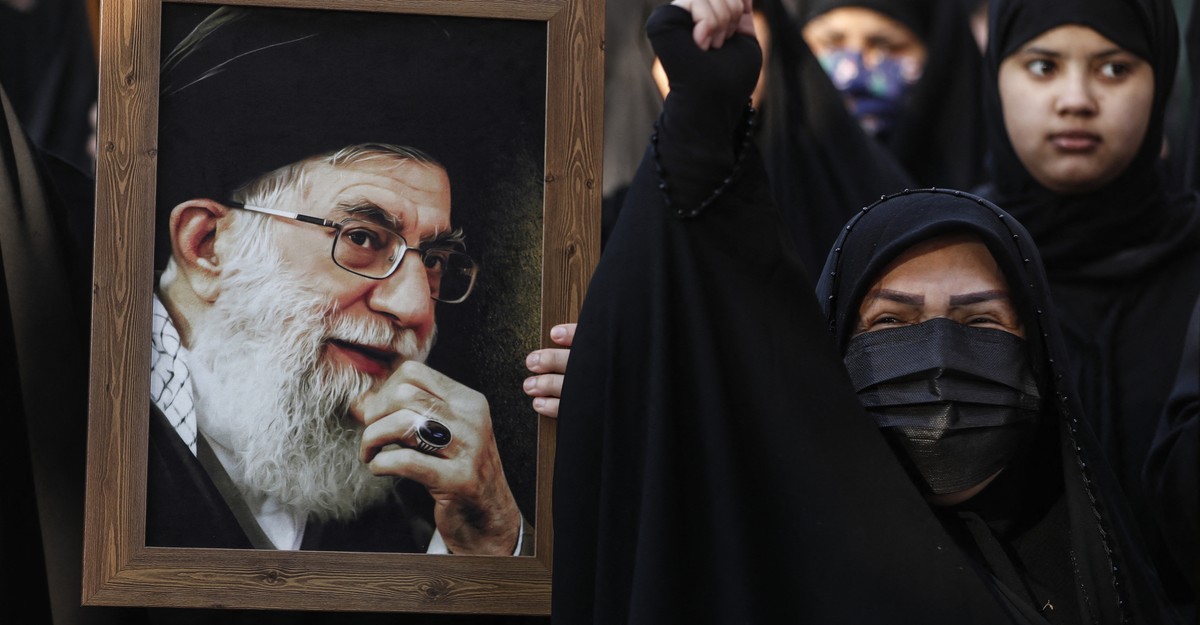
""The essence of oligarchical rule," George Orwell wrote in 1984, "is the persistence of a certain world-view and a certain way of life, imposed by the dead upon the living." For nearly four decades, Ayatollah Ali Khamenei presided over exactly that. He did not build the Islamic Republic of Iran. He inherited it from its founder, Ayatollah Ruhollah Khomeini, who in 1979 led a revolution that deposed a U.S.-aligned monarchy and replaced it with an Islamist theocracy."
"Khomeini died in 1989, and his successor's life's work was to keep that revolution alive long after the society it governed had moved on. In this Khamenei was remarkably, ruthlessly successful. But the world view he imposed was never truly his own. He was the spokesman for a ghost."
"Khamenei's rise was engineered not by destiny but by maneuver. In 1989, Ali Akbar Hashemi Rafsanjani, the shrewd speaker of Parliament and the son of a pistachio merchant, helped anoint Khamenei as supreme leader by claiming that it was Khomeini's dying wish. Rafsanjani likely believed he was working to install a pliant figurehead. Khamenei had other ideas."
"The rivalry between them endured for three decades. Rafsanjani favored détente with the United States and wealth creation; Khamenei believed that compromising on revolutionary principles would hasten the regime's collapse, just as perestroika had undone the Soviet Union."
Ayatollah Ali Khamenei served as Iran's supreme leader for nearly four decades, inheriting and perpetuating the Islamic Revolution established by Ayatollah Ruhollah Khomeini in 1979. Rather than creating his own vision, Khamenei devoted his tenure to preserving Khomeini's ideological framework centered on anti-American sentiment, anti-Israeli stance, and mandatory hijab enforcement. His rise to power in 1989 resulted from political maneuvering by Rafsanjani, who believed he was installing a compliant figurehead. However, Khamenei proved far more independent and ideologically committed than anticipated. A three-decade rivalry ensued between Khamenei, who opposed compromise with the West, and Rafsanjani, who favored détente and economic development. Khamenei's death represents a pivotal moment as the last first-generation founder of the regime.
#iranian-politics #islamic-revolution #khamenei-leadership #ideological-succession #regime-continuity
Read at The Atlantic
Unable to calculate read time
Collection
[
|
...
]