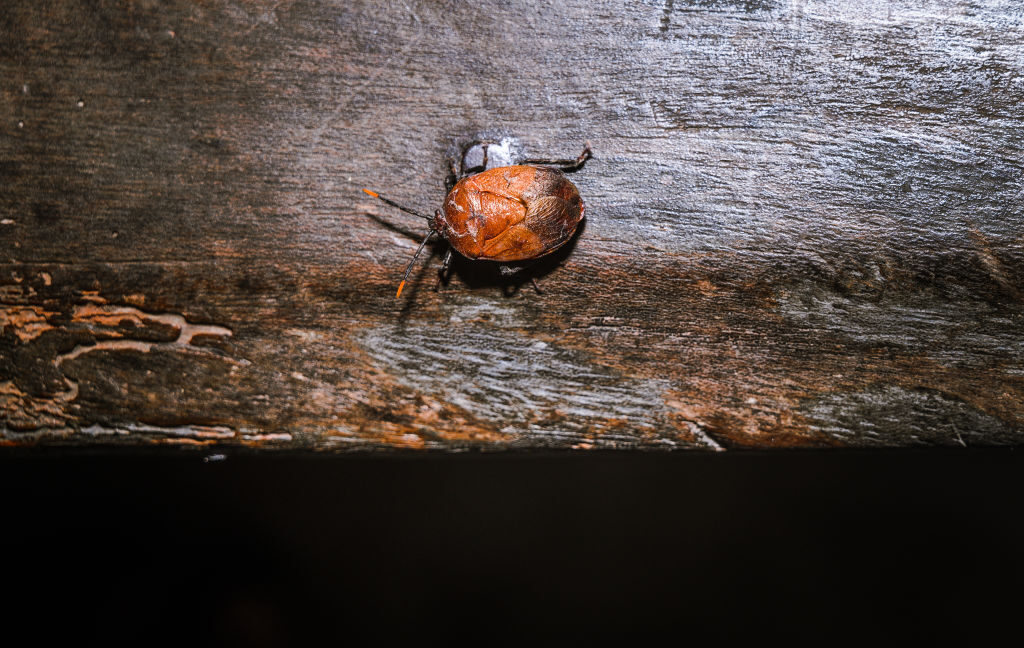
"Suspecting that they use their hind leg tympanal organs to listen to male courtship songs, a team of Japanese researchers took a closer look at the organs in Megymenum gracilicorne, a Dinidoridae stinkbug species native to Japan. They discovered that these "tympanal organs" were not what they seemed. They're actually mobile fungal nurseries of a kind we've never seen before."
"Dinidoridae is a small stinkbug family that lives exclusively in Asia. The bug did attract some scientific attention, but not nearly as much as its larger relatives like Pentatomidae. Prior work looking specifically into organs growing on the hind legs of Dinidoridae females was thus somewhat limited. "Most research relied on taxonomic and morphological approaches. Some taxonomists did describe that female Dinidoridae stinkbugs have an enlarged part on the hind legs that looks like the tympanal organ you can find, for example, in crickets,""
Female Megymenum gracilicorne possess enlarged structures on their hind legs that superficially resemble tympanal organs. Detailed anatomical analysis found no tympanal membrane, no auditory neurons, and no other auditory features in those structures. The hind-leg cavities instead contain living fungal tissue that grows and reproduces within portable chambers. The fungal lawns are nurtured, transferred between individuals, and provisioned for offspring, functioning as cultivated symbiont nurseries. These mobile fungal gardens represent a previously unrecognized insect–fungus symbiosis and redefine the biological role of the hind-leg organs in Dinidoridae stinkbugs.
Read at Ars Technica
Unable to calculate read time
Collection
[
|
...
]