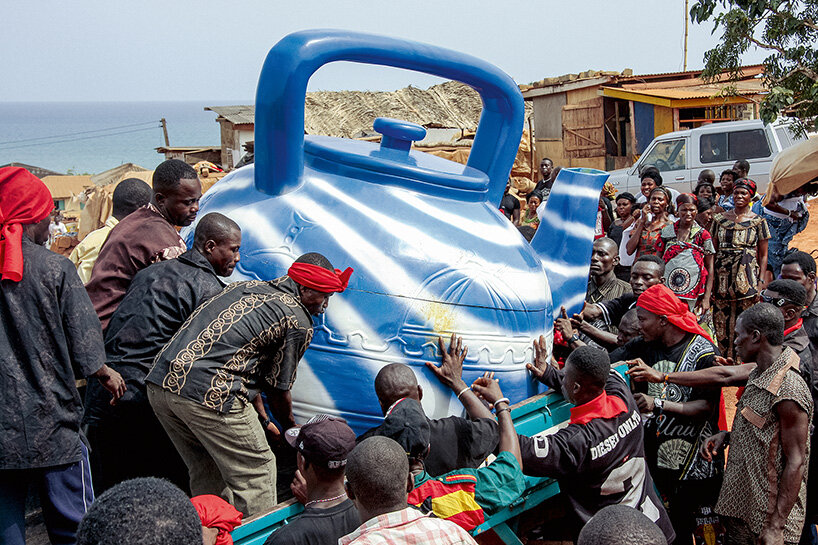
"When I started, there was still the idea that these coffins were 'invented,' and I didn't question it. I believed it. Only through time, proximity, and trust did that narrative begin to unravel... Slowly, mainly through Ataa Oko, through his drawings, I started to connect with this society, the religion, the use of the coffins, and their story."
"The coffins revealed themselves as expressions embedded in belief systems, lineage, and social hierarchy. Traditional families often choose restrained forms tied to totems or protective animals linked to family identity and spiritual power. It's more than a symbol."
Anthropologist Regula Tschumi documents Ghana's Ga-Adangme funerary traditions through twenty years of fieldwork, revealing how figurative coffins, ritual objects, and commemorative practices translate grief into visual and social forms. Initial assumptions about coffins being recently invented were challenged through relationships with coffin makers like Ataa Oko, whose historical drawings demonstrated deep cultural continuity. The coffins function as expressions embedded in belief systems, lineage structures, and social hierarchies rather than mere artistic innovations. Tschumi's long-term proximity and trust-building with communities revealed funerary culture as a living system of images, symbols, and social rules that operate as visual and social continuities within Ga-Adangme society.
#ga-adangme-funerary-culture #figurative-coffins #ritual-and-symbolism #anthropological-fieldwork #ghanaian-death-rituals
Read at designboom | architecture & design magazine
Unable to calculate read time
Collection
[
|
...
]