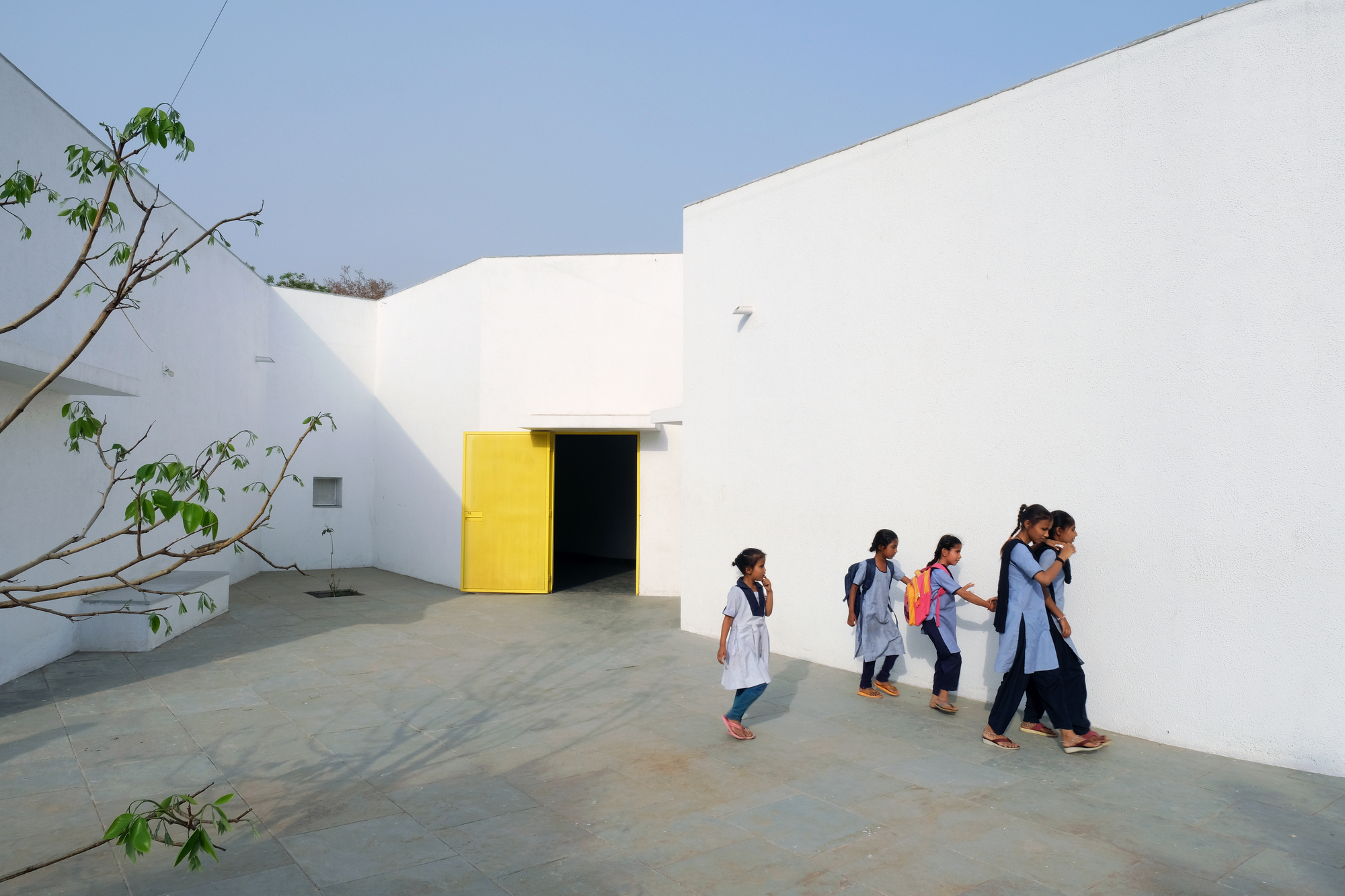
"We were confronted with a fundamental question: How do we design a school for users who do not primarily depend on vision, and who experience the world in their own unique way? The studio had no prior expertise in designing for visually impaired users, which meant the process began not with formal proposals, but with time spent on site, observing how students moved, paused, gathered, and navigated the existing campus."
"The geometry is deliberately simple: a contained plaza circled by a corridor, with classrooms plugged into it as smaller cells. This typology allows students to construct a mental map anchored by a consistent spatial center. The courtyard operates as the building's spatial anchor, allowing movement to recalibrate around a consistent reference point."
SEAlab, founded in 2015 by Anand Sonecha, approached the design of a new academic building for a School for Blind and Visually Impaired Children in Gandhinagar by first understanding how students perceive and navigate space without relying primarily on vision. Rather than imposing predetermined designs, the studio spent time observing how students moved through the existing campus. The resulting 750 m² building features ten classrooms of five different types arranged around a central courtyard. The deliberately simple geometry—a contained plaza circled by a corridor with classrooms as smaller cells—enables students to construct mental maps anchored by a consistent spatial center. This approach reflects SEAlab's broader philosophy of slow, contemplative engagement with place and participation.
#inclusive-design #spatial-perception #educational-architecture #accessibility #participatory-design
Read at ArchDaily
Unable to calculate read time
Collection
[
|
...
]