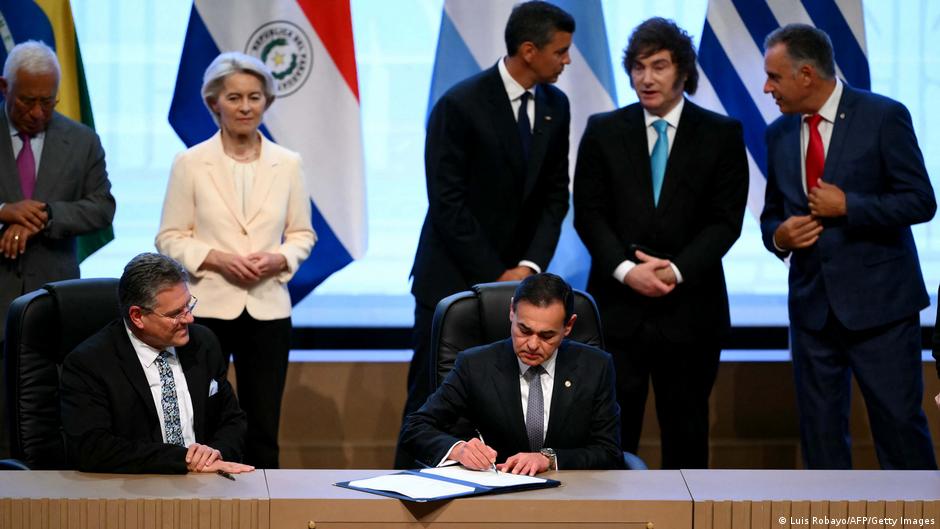
"Twenty-five years in the making, the EU-Mercosur deal a sweeping trade agreement between the European Union and the Latin American countries Brazil, Argentina, Paraguay and Uruguay has hit another roadblock, just days after being signed. The European Parliament who has yet to formally vote on the deal, voted on Wednesday, January 21, to send parts of the agreement to the European Court of Justice (ECJ) for a legality check."
"One of the initiators of the vote, Austrian Green MEP Thomas Waitz, told DW: "There are legitimate concerns, legal concerns, and it's important that the European Court of Justice checks them and gives advice on how to deal with these issues." Parliament wants the court to check one specific mechanism that could enable Brazil, Argentina, Paraguay and Uruguay to challenge EU rules if they think these infringe on their market access. "It's about standards of production and it's about a chilling effect on our sovereign right to legislate," says Waitz."
"The agreement could legally be applied provisionally, without the okay from Parliament. German Chancellor Friedrich Merz floated the idea just hours after the EP vote, and some Members of Parliament voiced support as well. The European Council has already given its green light. "I invite the Commission to use this decision from the Council and to implement the provisional application of the Mercosur agreement," Council President Antonio Costa said after the informal Council summit on January 23. For provisional application to begin, at least one member state would need to ratify the deal first. That could happen as early as this week."
Negotiations over the EU-Mercosur trade deal have stalled after the European Parliament voted to refer parts of the agreement to the European Court of Justice for a legality check. MEPs want review of a mechanism that could allow Mercosur countries to challenge EU rules, raising concerns about production standards and national legislative sovereignty. The final parliamentary vote is likely to be postponed until after an ECJ ruling, potentially months or years away. The European Council approved the deal and leaders have urged provisional application, which could begin if at least one member state ratifies the agreement.
Read at www.dw.com
Unable to calculate read time
Collection
[
|
...
]