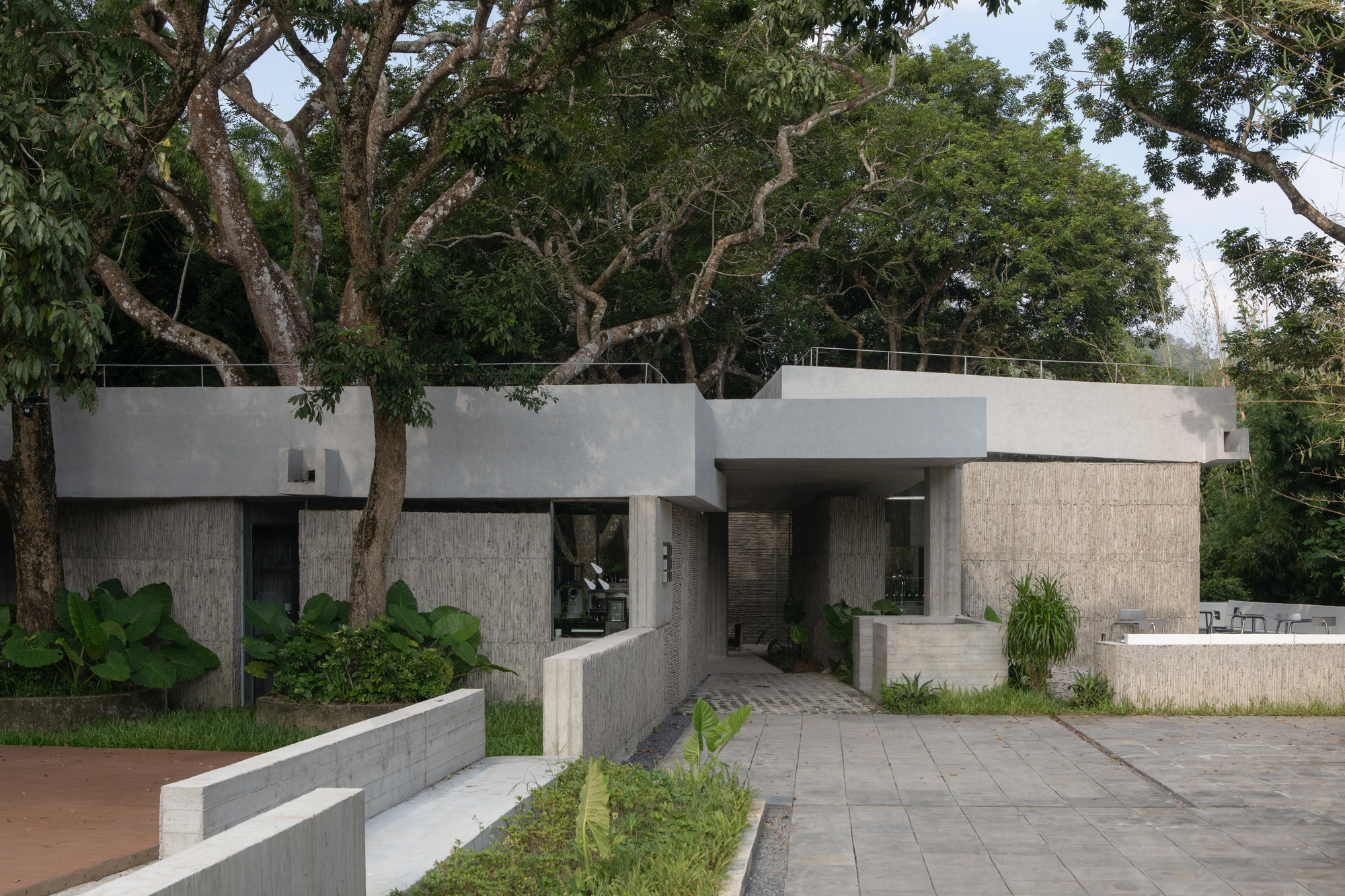
"The Noon Repose Pavilion is located on the bank of a rural river in Huizhou, a city in southern China, along the scenic route encircling Nankun Mountain and Luofu Mountain. Huizhou was once a place of exile for the Northern Song scholar Su Shi. During his years there, exile did not result in withdrawal from life, but rather intensified his attention to its everyday rhythms."
"In his writings, he identified what he called the "sixteen pleasures of life," one of which he described as "resting at noon on a simple rattan pillow." The pavilion takes its name from this phrase. It is not intended as a nostalgic reference, but as a way of anchoring contemporary experience to a different understanding of time-one that allows for pause, slackening, and repose. What is recalled here is not a historical figure, but a mode of living that remains possible in the present."
The Noon Repose Pavilion sits on the bank of a rural river in Huizhou along the scenic route around Nankun and Luofu Mountains. Huizhou served as a place of exile for the Northern Song scholar Su Shi, whose exile intensified attention to everyday rhythms. Su Shi named one of the "sixteen pleasures of life" as resting at noon on a simple rattan pillow. The pavilion takes its name from that phrase and seeks to anchor contemporary experience in an alternative understanding of time that permits pause, slackening, and repose. The emphasis is on a living mode still possible today.
Read at ArchDaily
Unable to calculate read time
Collection
[
|
...
]