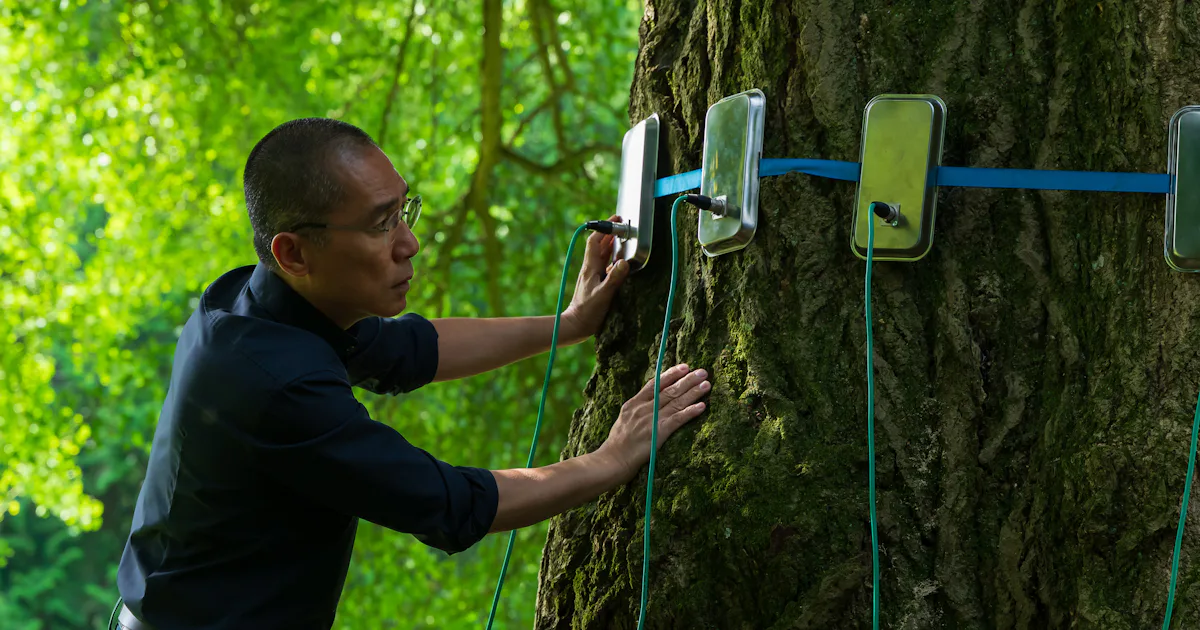
A neurology professor becomes quarantined during early 2020 lockdowns and begins studying an old ginkgo tree at Marburg University, dating to 1832. Neurological experiments suggest the tree is conscious and responds to stimuli in ways that resemble communication. Earlier attempts at human-to-plant communication appear through flashbacks, including a 1908 botany student who develops a strong affinity for the ginkgo and a 1972 student who connects a purple geranium to sensors. The 1972 experiment leads to the plant opening a gate, based on a newspaper account of a Canadian scientist using sensors on a potted plant. The findings rely on electric impulses indicating perception of the surrounding world.
"Dr. Tony Wong (Tony Leung), a neurology professor who encounters the gingko tree at Marburg University, where he becomes unexpectedly quarantined at the start of the 2020 lockdowns. Struck by the gingko tree and its long history at the university, which he finds dates back to 1832, he starts to apply his neurological experiments to it, hoping to prove that plants are conscious."
"What he finds: Not only is the gingko tree conscious, it responds to stimuli in a way that hints at a form of communication. But he's not the first person to make this discovery. As Silent Friend goes on, it flashes back through the years to other people who have attempted human-to-plant communication: first, the first female botany student (Luna Wedler) at Marburg University in 1908, who develops an affinity for the ginkgo tree; then, an awkward loner student (Enzo Brumm) in 1972 who discovers that a purple geranium hooked to a sensor will respond to him."
"The latter experiment - in which the '70s student is actually able to get the geranium to open a gate for him - was based on a newspaper article that director Ildikó Enyedi had read about in the '70s, and served as the inspiration for Silent Friend. "I was a teenager in the '70s, so it was full-speed flower power, world peace, 'Let's figure out how to live in another way,'" Enyedi tells Inverse."
""It was a beautiful time. These experiments were very primitive, very basic. They just put sensors on all sorts of plants, and they were amazed that the plant actually, through electric impulses, shows signs of perceiving the surrounding world." In the article that Enyedi read, a Canadian scientist put some sensors on a potted plant in his window."
#plant-consciousness #neuroscience-experiments #human-to-plant-communication #ginkgo-tree #electric-impulses
Read at Inverse
Unable to calculate read time
Collection
[
|
...
]