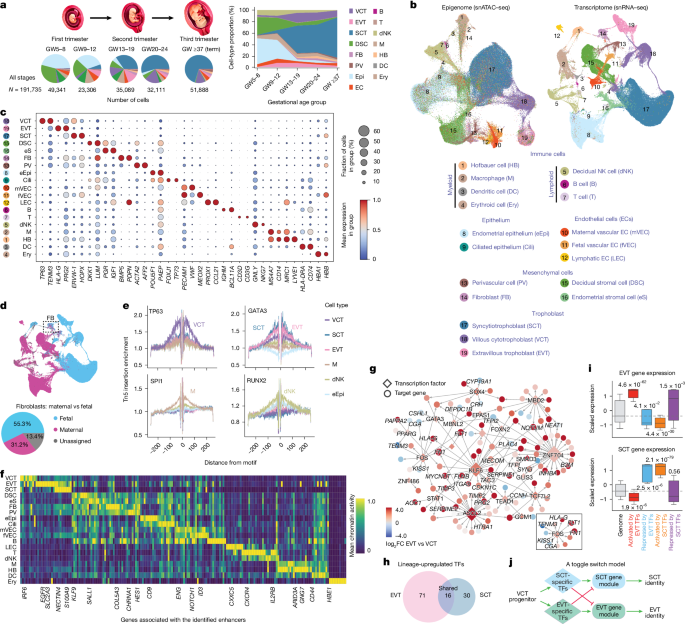
"The human maternal-fetal interface (MFI) is a transient hemi-allogeneic amalgam in which maternal decidual stromal cells (DSCs) support placental attachment, recruit immune cells and create a tolerogenic milieu for patterning fetal cytotrophoblast invasion."
"Fetal villous cytotrophoblasts (VCTs) in floating villi fuse into syncytiotrophoblasts (SCTs), which mediate nutrient and waste exchange and hormone and growth factor secretion, and limit fetal cortisol exposure."
"By the end of the first trimester, EVT remodelling of these vessels establishes low-resistance arteries that enable high-velocity blood flow to the placenta."
"This framework catalogues diverse cell types, resolves transient states and trajectories, maps intercellular communication in situ, and pinpoints vulnerable cell states in pregnancy complications."
The maternal-fetal interface (MFI) is a complex structure where maternal decidual stromal cells support placental attachment and immune tolerance. Fetal villous cytotrophoblasts develop into syncytiotrophoblasts for nutrient exchange and hormone secretion. Extravillous trophoblasts invade the decidua and remodel uterine arteries for efficient blood flow. A comprehensive single-nucleus multiomics study was conducted to map the MFI from early gestation to term, cataloging diverse cell types and their interactions, while identifying vulnerable states linked to pregnancy complications.
#maternal-fetal-interface #placental-development #single-cell-analysis #pregnancy-complications #immune-tolerance
Read at Nature
Unable to calculate read time
Collection
[
|
...
]