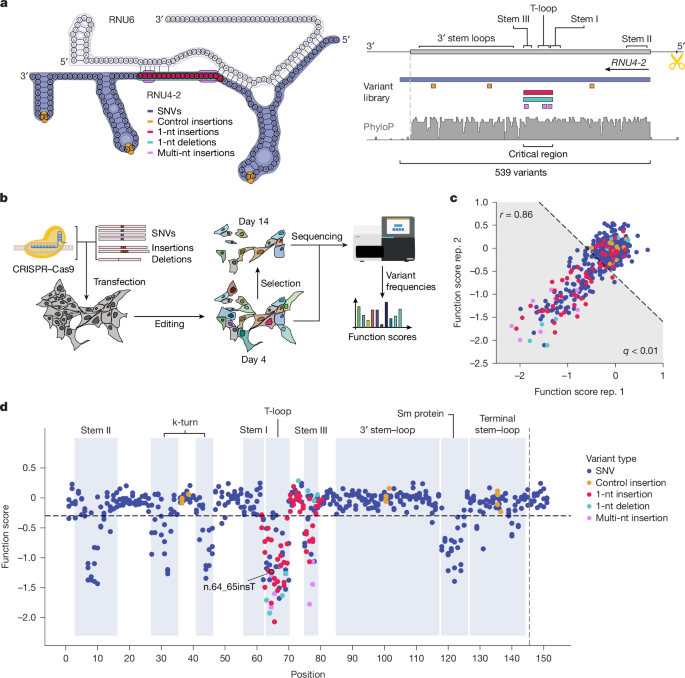
ReNU syndrome is linked to de novo variants in the RNU4-2 gene, which encodes a small nuclear RNA essential for RNA splicing. This disorder presents with global developmental delays, intellectual disabilities, hypotonia, and seizures. Variants cluster in a critical 18-nucleotide region of RNU4-2, affecting splice site usage and correlating with clinical severity. The relationship between genetic variations in RNU4-2 and their clinical impacts is not fully understood, with potential variants outside the critical region also needing investigation due to the high mutation rate in snRNA genes.
"ReNU syndrome is a complex multi-system disorder characterized by moderate to severe global developmental delay, intellectual disability, hypotonia, acquired microcephaly, speech and motor difficulties, low bone density and often seizures."
"Variants identified in individuals with ReNU syndrome cluster in an 18-nucleotide (nt) region in the centre of RNU4-2 that is depleted of variants in population datasets."
"The U4/U6 duplex needs to be unwound for activation of splicing, and variants causing ReNU syndrome have been shown to alter 5′ splice site usage."
"The precise relationship between genetic variation in RNU4-2 and clinical impact remains incompletely characterized, with potential variants outside the critical region also needing investigation."
Read at Nature
Unable to calculate read time
Collection
[
|
...
]