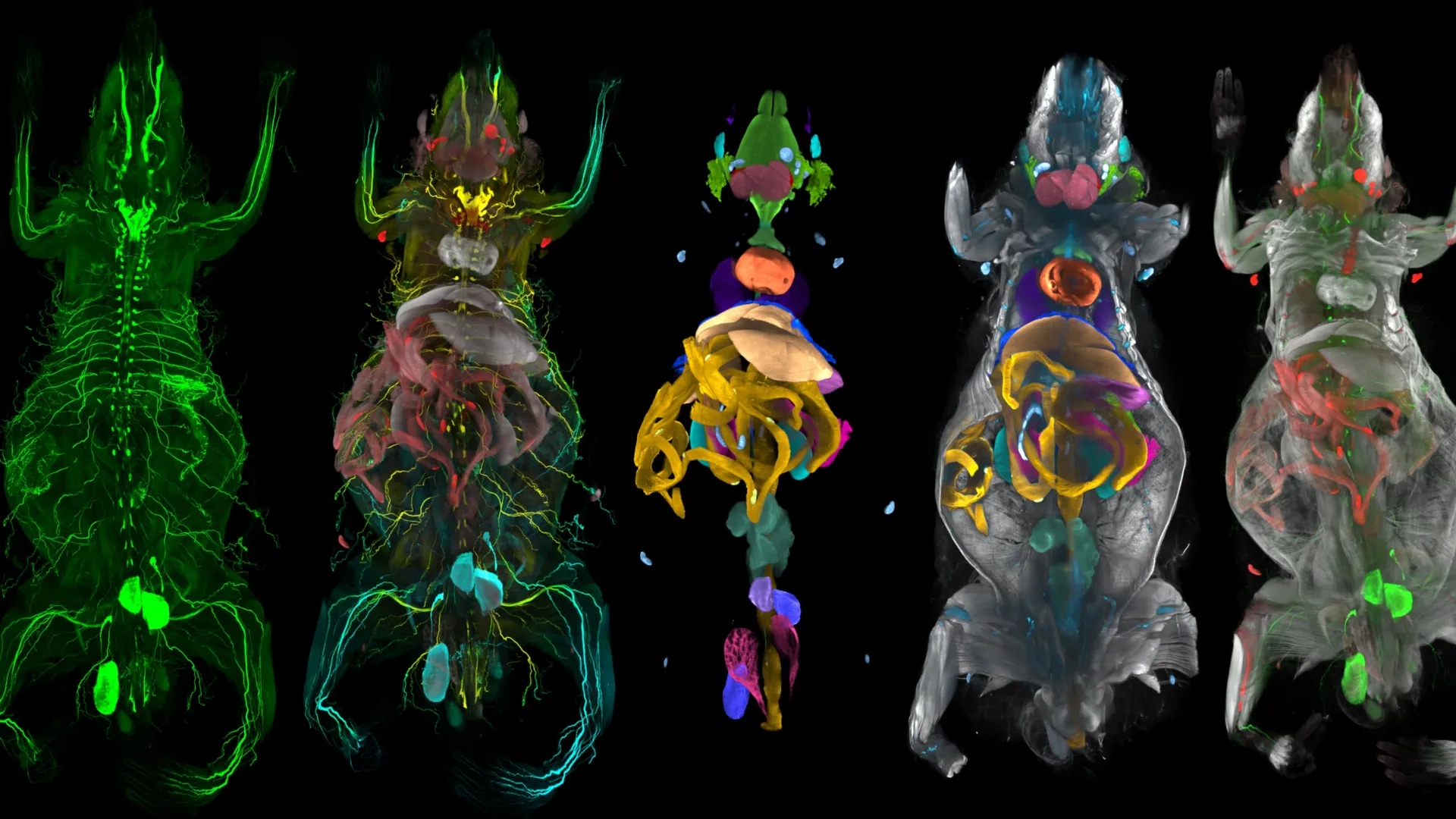
MouseMapper is an AI system that maps disease-related changes throughout an intact mouse body at cellular-level detail. The platform uses foundation-model-based deep learning to analyze large whole-body imaging datasets. It automatically identifies and segments 31 organs and tissue types and maps nerves and immune cells across the body. Using this capability, researchers found widespread inflammation and previously unknown nerve damage associated with obesity. The work also detected similar molecular patterns in human tissue, indicating that key aspects of obesity-related nerve damage may occur in both mice and people. The approach addresses the lack of tools for studying whole-body disease effects in high detail.
"Researchers at Helmholtz Munich, Ludwig Maximilians University Munich (LMU), and several partner institutions have created an artificial intelligence (AI) system capable of mapping disease-related changes throughout an entire mouse body at cellular-level detail. Using the new platform, known as MouseMapper, the team discovered widespread inflammation and previously unknown nerve damage linked to obesity."
"The system can automatically identify and segment 31 organs and tissue types while also mapping nerves and immune cells throughout the body. This allows researchers to examine how diseases affect multiple organ systems at the same time in intact mice."
"The study also identified similar molecular patterns in human tissue, suggesting that important aspects of obesity-related nerve damage may occur in both mice and people. The findings were published in the journal Nature."
"MouseMapper is built on a foundation model, which means it generalizes far beyond the data it was originally trained on,"
#whole-body-3d-reconstruction #ai-based-medical-imaging #obesity #neuroinflammation #translational-research
Read at ScienceDaily
Unable to calculate read time
Collection
[
|
...
]