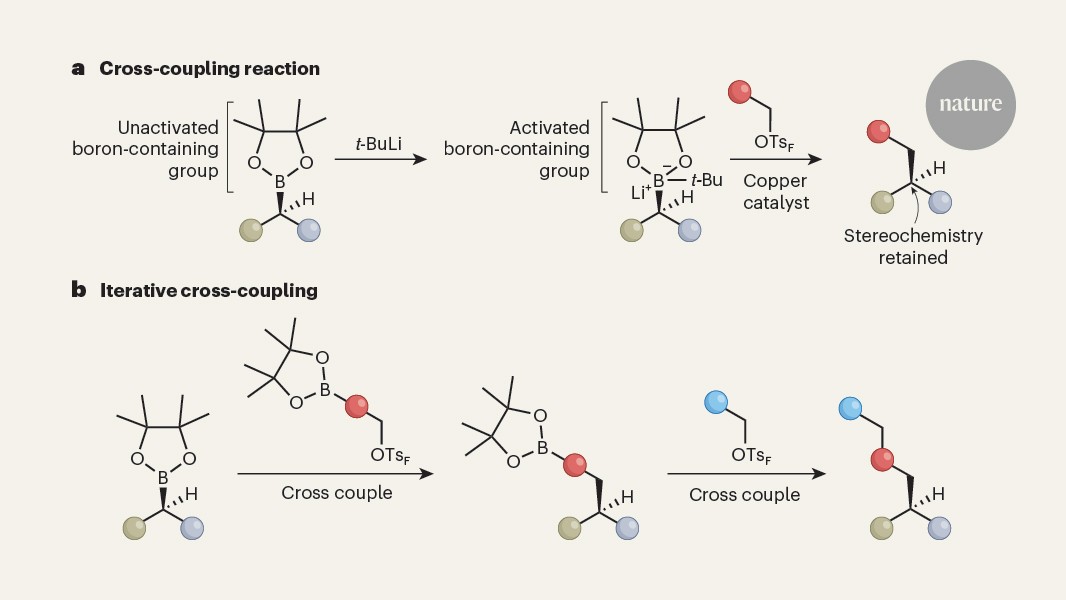
"Small organic molecules underpin modern life, from medicines and flavours to advanced materials. Much of this functional diversity comes from shape: modest changes in a molecule's 3D structure can completely change its properties."
"Chemists often synthesize libraries of compounds through the Lego-like assembly of molecules from interchangeable chemical building blocks. However, such approaches are only as useful as the types of carbon-carbon (C-C) bond that form between the building blocks during assembly."
"Zhang et al. report chemistry that not only enables the modular and iterative synthesis of a ubiquitous type of C-C bond - C(sp3)-C(sp3) bonds - but that also controls the 3D configuration of the attached atoms."
The modular synthesis of 3D organic molecules is crucial for drug discovery and materials design. Small organic molecules are essential for various applications, and their properties are significantly influenced by their 3D structure. Chemists utilize interchangeable chemical building blocks to create libraries of compounds. The recent work by Zhang et al. introduces a method for synthesizing C(sp3)-C(sp3) bonds, which allows for the control of the 3D configuration of attached atoms, enhancing the efficiency of structural exploration in organic chemistry.
Read at Nature
Unable to calculate read time
Collection
[
|
...
]