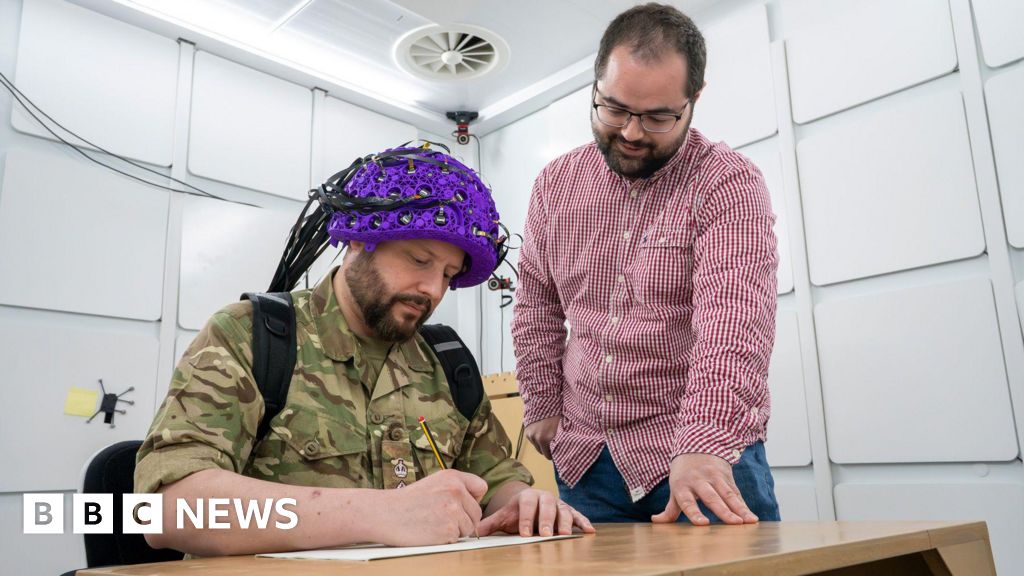
"A team at the universities of Nottingham and Birmingham has used 3.1m of Ministry of Defence funding to develop a vehicle-based lab that can be taken to field hospitals, firing ranges and rehabilitation centres. It will allow the study of how blast and other trauma affects brain function within minutes of the event, far faster than relying on static equipment, scientists said."
"It is rather like the mobile MRI scanners which can be sent out to where ever they are needed. "So before, we would have had the system in one place and had to take the personnel there, now the system can be taken where ever the personnel are, whether than is the Brecon Beacons or the highlands of Scotland.""
"The study will focus on how brains are affected by shockwaves produced by personnel using weapons. Prof Mullinger said: "We know there are differences in their behaviour within the first 24 hours after they come off the training range. "But that disappears and if we can't monitor them quickly we might be missing any damage which has happened.""
A vehicle-based mobile magnetoencephalography (MEG) scanner is being developed to measure immediate brain effects of blast exposure in soldiers. The project received £3.1m Ministry of Defence funding to create a lab that can be deployed to field hospitals, firing ranges, and rehabilitation centres. The system can study brain function within minutes of traumatic events, enabling faster monitoring than static equipment. The scanner is believed to be the world's first fully mobile MEG and operates by using magnets to monitor real-time brain activity. Advances in energy efficiency, shielding, and cooling made the mobility possible. Applications include sports concussion, dementia and epilepsy research.
Read at www.bbc.com
Unable to calculate read time
Collection
[
|
...
]