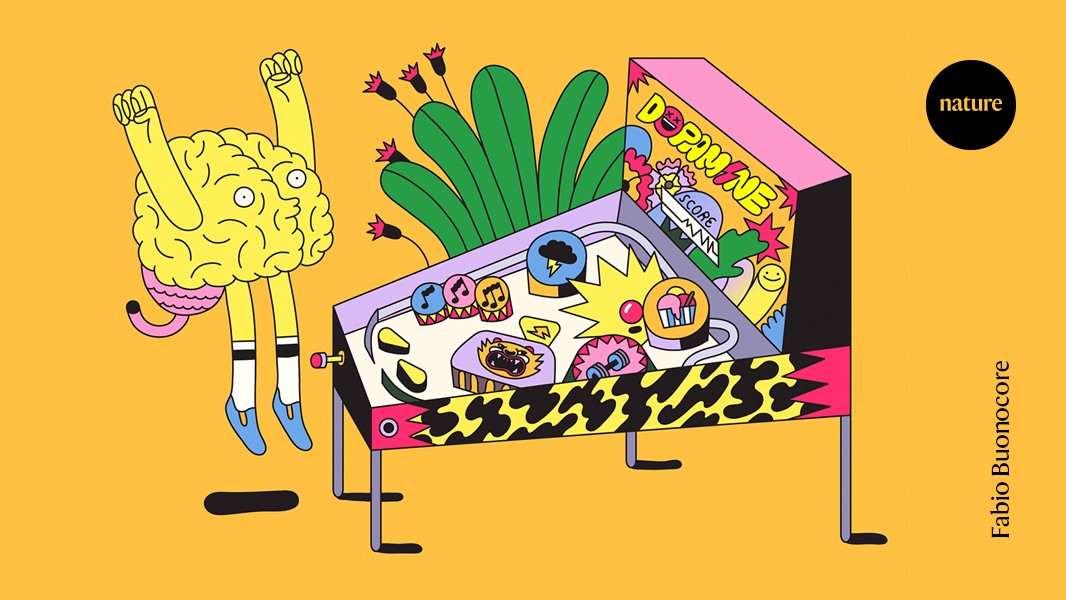
"Dopamine is one of the most extensively studied neurotransmitters, chemicals that convey signals from cell to cell. It's the one with the highest profile outside neuroscience: often known as the 'pleasure chemical', it's depicted as the hit of reward that people get from recreational drugs or scrolling through social media. That's a gross simplification of what dopamine does; on that, researchers agree."
"The classic idea, known as the reward prediction error (RPE) hypothesis, is that bursts of dopamine in the brain link stimuli to rewards, helping to reinforce associations that fulfil a need for an animal or a person. The model has dominated and guided research in the field for decades, offering a mathematical framework to interpret data from animal experiments, and it does a good job of explaining behaviour."
"Dopamine was the one field of neuroscience where we had a computational model that explained what the signal was and what it was computing. This was a valuable rarity for researchers struggling to overlay simple theories onto the intense complexity of the brain."
Dopamine, commonly mischaracterized as the 'pleasure chemical,' is one of neuroscience's most studied neurotransmitters. The reward prediction error (RPE) hypothesis has dominated the field for decades, proposing that dopamine bursts link stimuli to rewards and reinforce behavioral associations. This model provided neuroscience with a rare computational framework for interpreting animal experiments and explaining behavior. However, researchers now challenge this theory, proposing amendments or complete overhauls. These debates have significant implications beyond basic neuroscience, potentially affecting clinical understanding and treatment of conditions like ADHD and addiction. If the current model requires modification, assumptions about what drives these disorders and optimal treatment approaches may also need revision.
#dopamine-neurotransmitter #reward-prediction-error-hypothesis #neuroscience-research-debate #adhd-and-addiction-treatment #brain-computational-models
Read at Nature
Unable to calculate read time
Collection
[
|
...
]