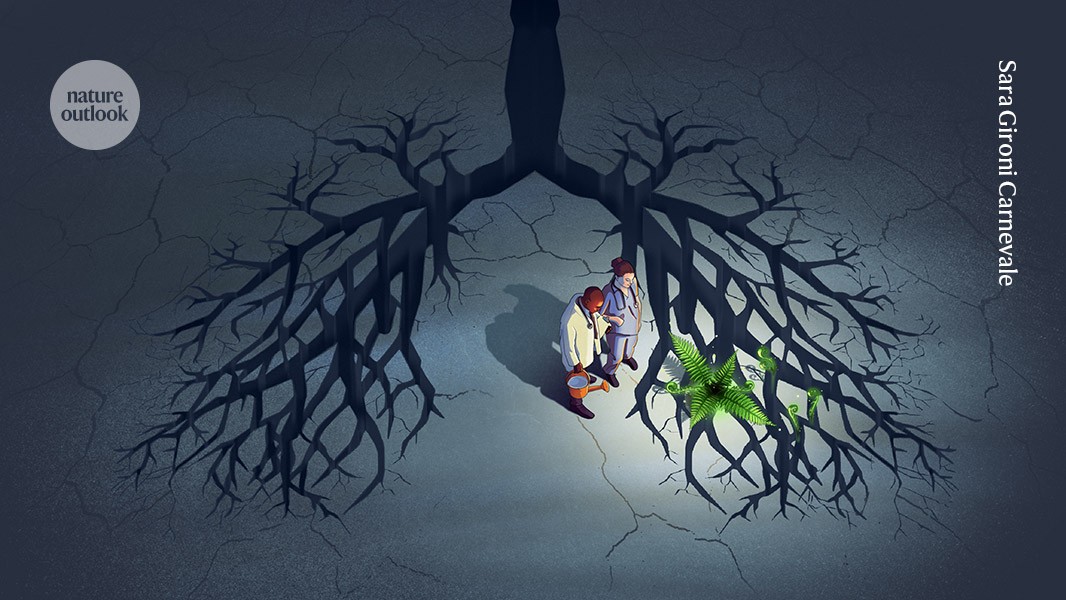
"When surgeons removed a 33-year-old woman's right lung as part of her cancer treatment in 1995, they expected a dramatic and permanent reduction in her breathing power. But that's not what happened. Instead, her remaining lung pulled off a trick that scientists had long thought impossible in humans: it grew new tissue, and lots of it. Over the next 15 years, her left lung compensated for the loss of its partner by nearly doubling in volume and growing millions of new air sacs, called alveoli."
"Over the past decade or so, researchers have started exploring the regenerative abilities of the lungs in earnest. The findings are changing how scientists see the organ. It is becoming clear that lungs, although quiescent when undisturbed, are able to react and respond to injury or infection, thanks to specialized cells that have a surprising ability to morph from one type to another. Faults in this process are also emerging as key mechanisms behind lung diseases, such as chronic obstructive pulmonary disease (COPD)."
"Such treatments are sorely needed. "COPD is the third leading cause of death in the world," says Ed Morrisey, a biologist who studies lung development and regeneration at the University of Pennsylvania in Philadelphia. "And yet we don't have any really good therapy." For other diseases such as idiopathic pulmonary fibrosis (IPF) - a fatal condition in which the lungs become progressively scarred and stiff - the outlook is similarly bleak. Even with a lung transplant, respite"
A human lung can regenerate substantial tissue after major loss, with a remaining lung nearly doubling in volume and growing millions of new alveoli over 15 years. Lungs are generally quiescent when undisturbed but can react and respond to injury or infection. Specialized cells in the lung can morph from one type to another to support repair and regrowth. Faults in these cell-state transitions are emerging as key mechanisms behind diseases such as chronic obstructive pulmonary disease (COPD). COPD is a leading global killer and currently lacks effective therapies, and idiopathic pulmonary fibrosis (IPF) causes progressive scarring and poor prognosis. Exploring lung regenerative biology raises the possibility that COPD and similar conditions could be slowed, stopped or reversed.
Read at Nature
Unable to calculate read time
Collection
[
|
...
]