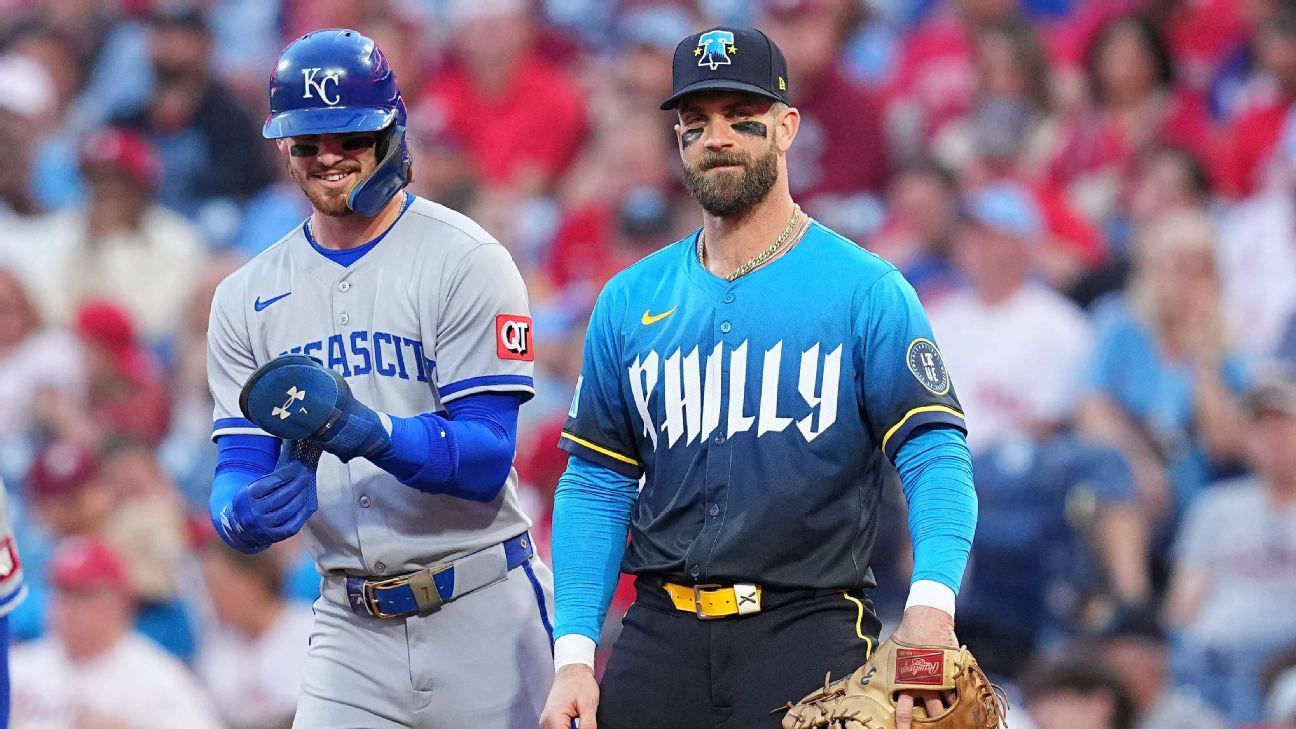
"In 2024, shortstops produced a .728 OPS compared to .701 for third basemen. In 2025, shortstops produced a .723 OPS compared to .705 for third basemen. This may not seem like a big deal, but given the long lens of baseball history, this is a significant change in the game, one of the most under-the-radar developments in recent years."
"Baseball-Reference has positional hitting data going back to 1912, and only twice before 2024 had shortstops hit for a higher OPS, in 1922 (one point better) and 1933 (nine points better). In fact, third basemen usually hit much better; the historical average since 1912 is plus-53 points of OPS for third basemen."
"This generation of shortstops, however, not only can field the position but also includes some of the best hitters in the game: Bobby Witt Jr. and Francisco Lindor and Gunnar Henderson and Trea Turner and Geraldo Perdomo and on and on. In MLB, few teams are satisfied with good-fielding, light-hitting shortstops anymore."
For the first time in over a century of recorded baseball history, shortstops have outhit third basemen in consecutive seasons. In 2024 and 2025, shortstops posted higher OPS than third basemen, reversing a long-standing trend where third basemen historically averaged 53 points better OPS since 1912. This shift reflects a fundamental change in how teams value the shortstop position. Modern shortstops like Bobby Witt Jr., Francisco Lindor, and Gunnar Henderson combine elite defensive skills with exceptional offensive production. Teams no longer accept light-hitting shortstops, demanding both defensive excellence and significant offensive contributions. This contrasts sharply with 1977, when top shortstops hit minimal home runs, and represents a departure from baseball's traditional defensive spectrum.
#mlb-positional-evolution #shortstop-offensive-production #baseball-historical-trends #defensive-spectrum-shift #modern-player-development
Read at ESPN.com
Unable to calculate read time
Collection
[
|
...
]