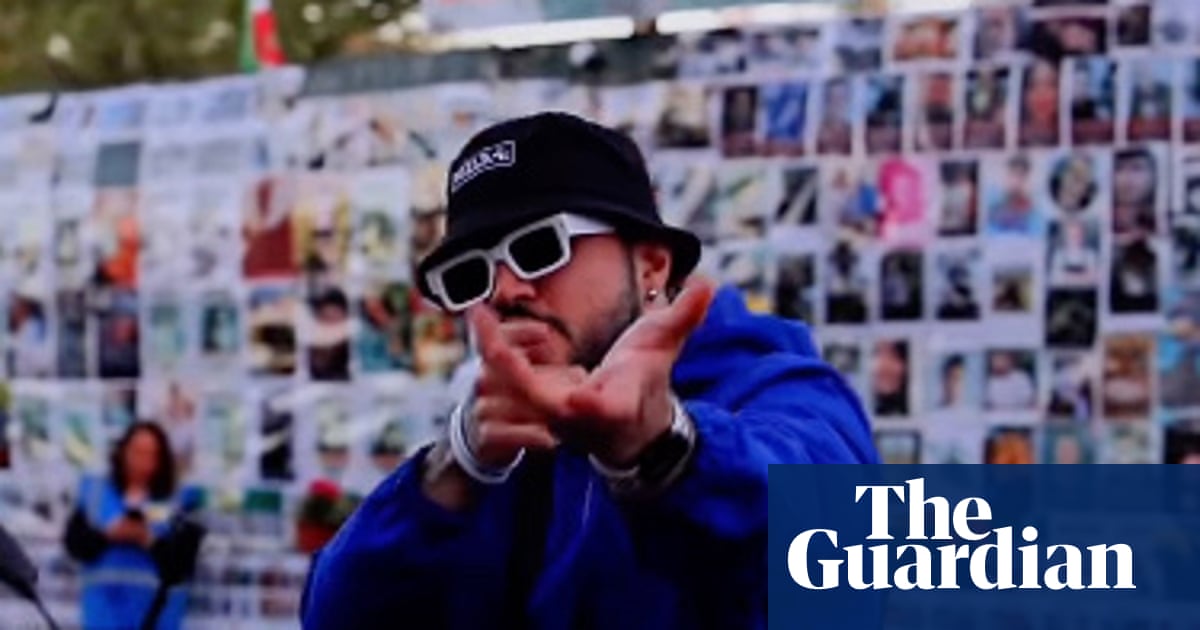
A rapper in London performs a drill-style rap while referencing Iranian paramilitary and military groups. The performance includes chest-bumping near a memorial wall and imagery of protesters killed under the Iranian regime. The lyrics imitate firing weapons and name Basij, the Islamic Revolutionary Guard Corps, and the Mojahedin. The rap is described as a remix of an Israeli hip-hop war anthem. The performer advocates a return to the Pahlavi monarchy, specifically Reza Pahlavi. The Mojahedin-e-Khalq is described as an exiled armed opposition group that later distanced itself from its earlier Shia and Marxist roots, promoting a democratic secular Iran. The scene is framed as an internal opposition conflict occurring on London streets rather than a simple pro- versus anti-regime divide.
"Mohraz starts to rap. Basij, one, two, shoot. IRGC, one, two, shoot. Mojahedin, one, two, shoot, he drills for the benefit of a camera while imitating firing a weapon. The rap from Mohraz an advocate for the return to the Iranian throne of the Pahlavi dynasty, specifically Reza Pahlavi, the exiled son of the late shah is a remix of a hip-hop war anthem popular in Israel, called Harbu Darbu (slang borrowed from Syrian Arabic which, in Hebrew, means to rain hell on an opponent)."
"The Basij he is pretending to shoot is a paramilitary organisation that is known as the iron fist of Iran. The IRGC referenced is the Islamic Revolutionary Guard Corps, the regime's most powerful political and military institution. And then there is the mention of the Mojahedin. The People's Mojahedin Organization of Iran (PMOI), more commonly known as the Mojahedin-e-Khalq (MEK), was part of the revolution against the western-backed shah in 1979 but became an exiled armed opposition group fighting the new regime from Iraq."
"The MEK today publicly distances itself from its Shia Islam and Marxist background and claims to speak, both at home and abroad, for those who want a democratic secular Iran rather than the return of a monarchy that ended with the exile of Shah Mohammad Reza Pahlavi 47 years ago. The aggressive drill music made by Mohraz, 28, whose 021kid moniker derives from the phone code in his home city of Tehran, is only the most public evidence of a battle being played out on the streets of London that is not between supporters and opponents of the Iranian regime but instead within the opposition."
Read at www.theguardian.com
Unable to calculate read time
Collection
[
|
...
]