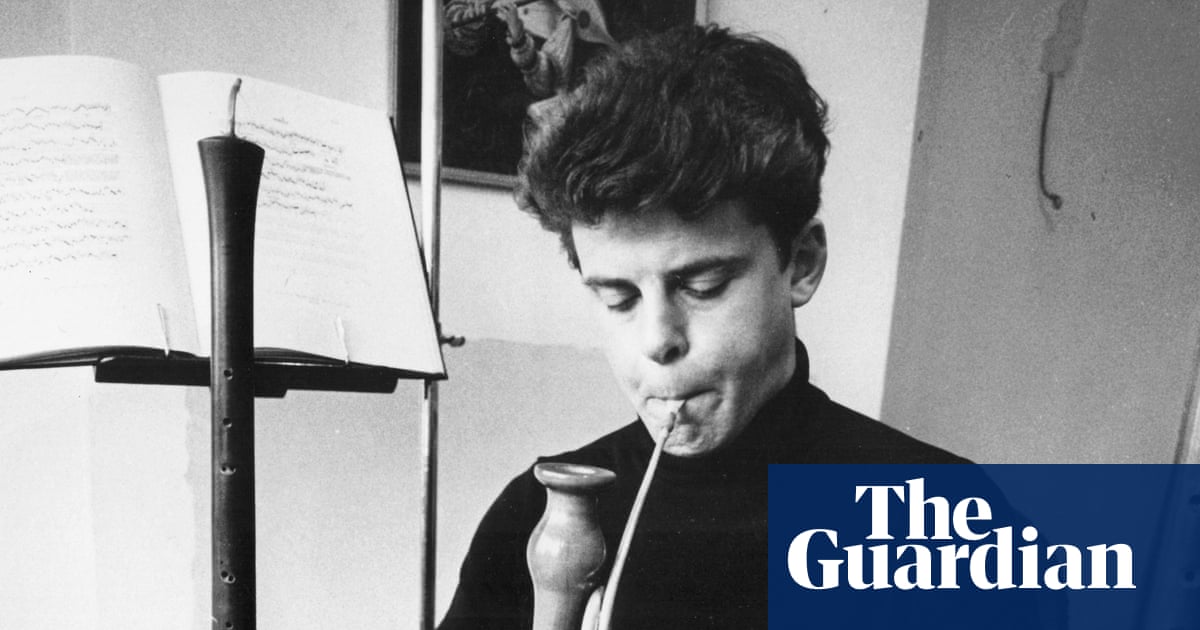
"In March 1968, a 25-year-old musician strode on to the stage of London's Wigmore Hall with a collection of unusual instruments. He proceeded to entertain the audience with tongue-in-cheek descriptions of a shawm, a crumhorn and a rackett the first time they'd ever been seen, let alone heard, on the Wigmore stage and he played them with breathtaking virtuosity. That concert, the London debut of the Early Music Consort, was greeted with delight, which set the pattern of things to come."
"With all the bravura of the 1960s, David Munrow erupted into the world of early music and transformed what had been a minority interest into popular listening. The Wigmore Hall's programme for the Early Music Consort's first concert at the London venue. Photograph: Wigmore Hall His flame burned brightly, but briefly: in May 1976 he took his own life at the age of 33. But his impact lives on in the music he rediscovered and popularised, and the innovative ways in which he presented and performed it."
"The Dufay Collective's William Lyons has said that his own programming ethos was very much influenced by that of Munrow: variety and information. Recently, Skip Sempe, the director of Capriccio Stravagante, wrote that Munrow inspired all those who, however unconsciously, followed him with great professional and commercial success. To this day, I feel that every early musician in the UK owes their career to him."
"Munrow's playing has caused [these early] instruments to be taken seriously, wrote Meirion Bowen in a profile of the young virtuoso for the Guardian in 1971. To be thought of not merely as musical fossils, but as a range of sonorities that hold unlimited delights for the listener, and which today's composers can find an invaluable stimulus."
In March 1968, a 25-year-old musician performed at London’s Wigmore Hall with unusual early instruments, describing them humorously and playing them with exceptional skill. The concert, marking the London debut of the Early Music Consort, was received with strong audience delight and set a precedent for future performances. With the energy of the 1960s, he helped transform early music from a niche interest into widely enjoyed listening. He died by suicide in May 1976 at age 33, but his influence persisted through the music he revived and the innovative ways he presented it. His programming approach emphasized variety and information, and his playing helped establish early instruments as serious, engaging sources of sound and inspiration for listeners and composers.
Read at www.theguardian.com
Unable to calculate read time
Collection
[
|
...
]