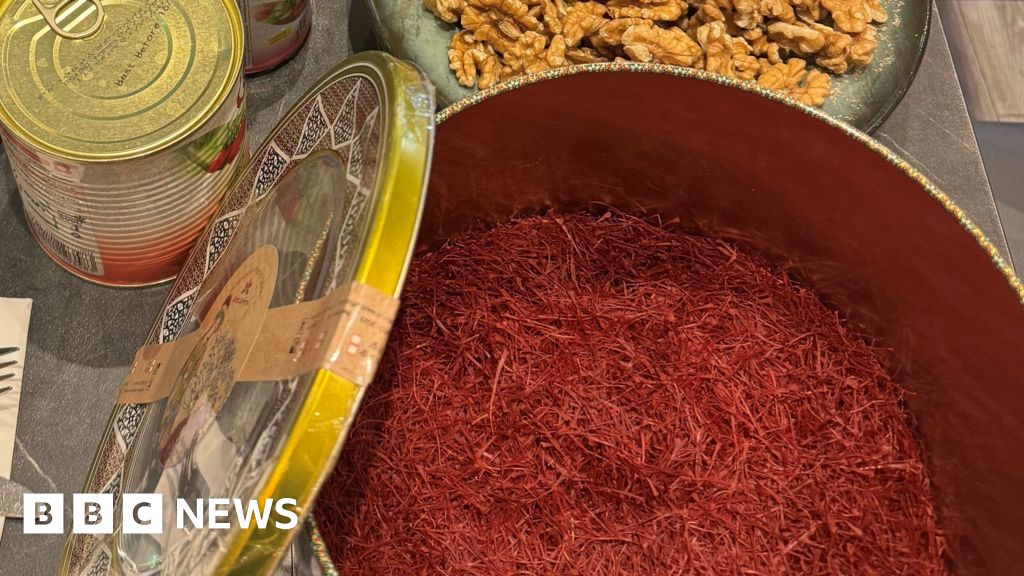
"“Any dishes coming out from the [Sadaf] kitchen with rice, there is layer of saffron on the top of it,” said Mahmoud. He explained that before the Middle East war he was buying saffron at about 1,200 per kilo, but now his supplier told him the cost has risen to about 2,000 to 2,100 per kilo. “It's quite a lot,” he said."
"“There is no substitute for Iranian saffron. We can't get the same quality, 85% of our dishes require saffron we use it in marinades for chicken breast and kebabs, and our saffron ice cream.” Saffron comes from the Crocus sativus flower which only blooms for a few weeks a year. The stigmas are hand-picked, but there are only three in each flower and it takes between 75,000 and 250,000 flowers to produce half a kilo (about 17 oz) of dried saffron."
"“We need to increase the prices we need to pass it to the customers, but I didn't do it. I'm still not doing it. ”I'm waiting for hopefully [when the war] is finished and we can keep the price as it is, so people can come out and enjoy the atmosphere of the Sadaf restaurant.”"
Saffron costs are increasing sharply for London businesses because war-related disruptions in Iran have reduced global supply. About 90% of the world’s saffron is grown in Iran, and blockade conditions affecting the Strait of Hormuz have also limited other staples such as chickpeas and zereshk. A west London Persian restaurant owner said he is trying to keep prices the same for customers despite higher costs. He reported saffron prices rising from around 1,200 per kilo to about 2,000 to 2,100 per kilo. He said there is no substitute for Iranian saffron because quality differs and saffron is used across many dishes, including marinades, kebabs, and saffron ice cream. Saffron production requires hand-picking stigmas from Crocus sativus flowers, with very low yields.
Read at www.bbc.com
Unable to calculate read time
Collection
[
|
...
]