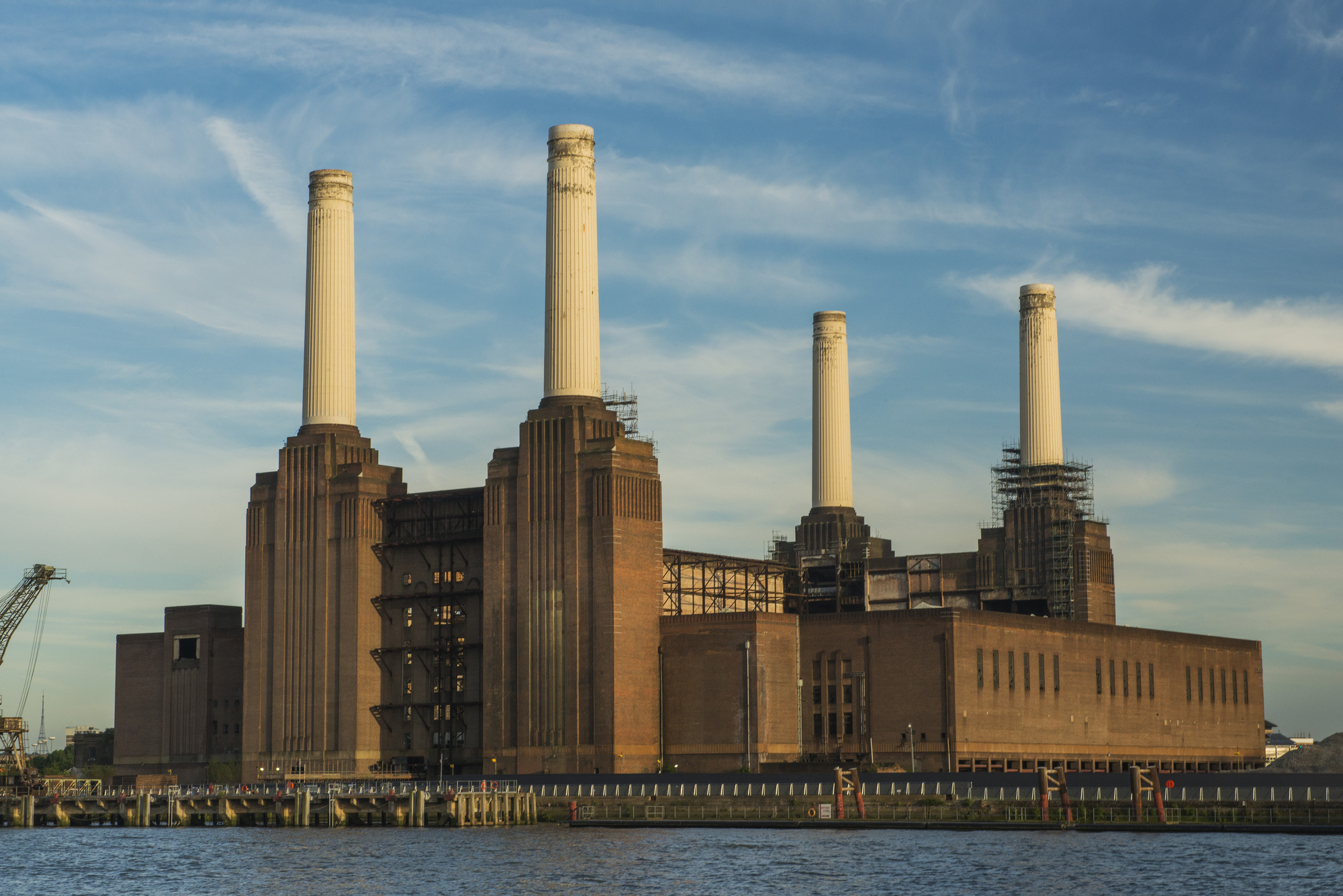
"Battersea Power Station is a former coal-fired power station located on the south bank of the River Thames in London, originally designed by architects J. Theo Halliday and Giles Gilbert Scott. Notable for its appearance on the cover of Pink Floyd's 1977 studio album Animals and in Alfred Hitchcock's 1936 film Sabotage, the station is one of the world's largest brick buildings and is known for its Art Deco interior fittings and décor."
"Today, the 42-acre (over 8 million sq ft) former industrial brownfield site is being transformed into an urban district with homes, shops, bars, restaurants, cafés, offices, and around 19 acres of public space. The transformation began with the station's decommissioning process between 1975 and 1983 and its listing in 1980, when the entire structure was granted Grade II status, later upgraded to Grade II* in 2007."
"The overall redevelopment project is divided into eight phases, each designed by a range of specialist architects. These include SimpsonHaugh and Partners and De Rijke Marsh Morgan (dRMM) for Circus West Village (Phase 1), completed in 2017 and now housing over 1,800 residents, along with a mix of bars, restaurants, and leisure facilities."
Battersea Power Station, constructed between 1929 and 1955 on London's Thames south bank, is one of the world's largest brick buildings designed by J. Theo Halliday and Giles Gilbert Scott. The iconic structure gained cultural prominence through appearances in Pink Floyd's 1977 album Animals and Hitchcock's 1936 film Sabotage. Decommissioned between 1975 and 1983, the site remained vacant until 2014. Redevelopment began in 2012, transforming the 42-acre brownfield into a mixed-use urban district featuring homes, shops, offices, and 19 acres of public space. The project, divided into eight phases with specialist architects, includes Circus West Village (Phase 1), completed in 2017 with over 1,800 residents. Studio Egret West was appointed to evolve the masterplan for the remaining 16 acres.
#industrial-heritage-redevelopment #mixed-use-urban-development #adaptive-reuse-architecture #london-riverside-regeneration #grade-ii-listed-building
Read at ArchDaily
Unable to calculate read time
Collection
[
|
...
]