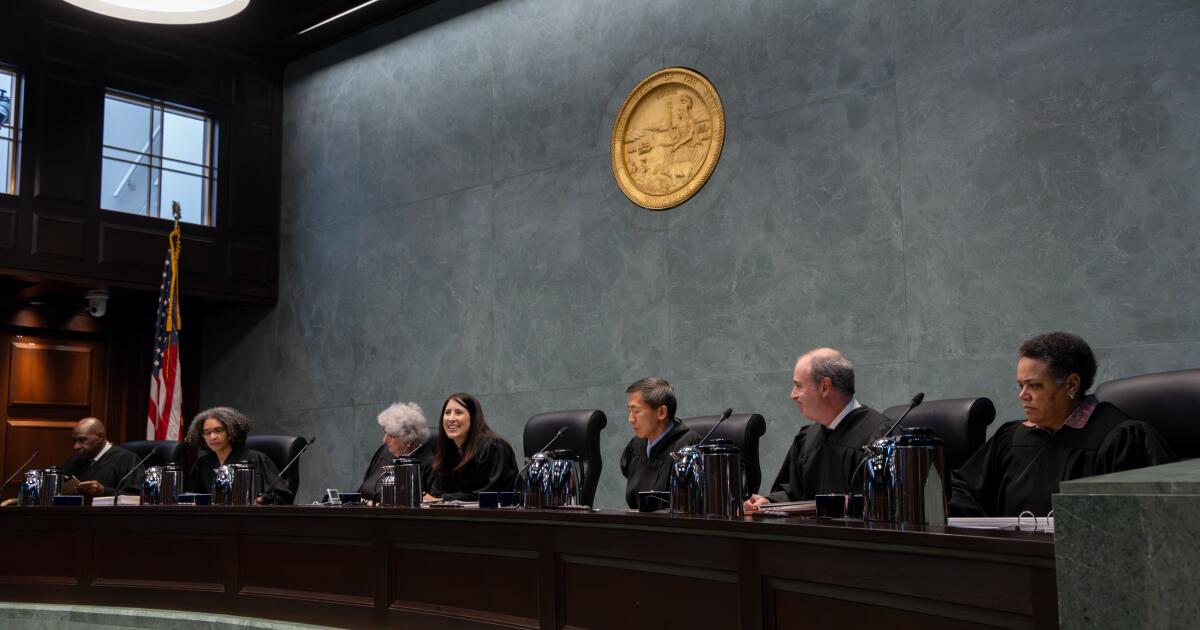
"The ruling irons out recent judicial efforts to protect California convicts from what Associate Justice Goodwin H. Liu called "cascading consequences" of administrative debt. "While a defendant's poverty does not make him any less subject to punishment for violating the law, our justice system must not punish a defendant more harshly simply because he is poor," Liu wrote in his concurrence."
"The case is one of scores to emerge in the wake of People v. Dueñas, a 2019 ruling from the state's appellate division that found imposing mandatory fines on indigent people ran afoul of the 8th Amendment, which prohibits excessive fines along with cruel and unusual punishment. Velia Dueñas was homeless mother with cerebral palsy and two young children who ended up behind bars and drowning in debt because she continued to drive after her license was suspended over three unpaid citations"
The California Supreme Court vacated hundreds of dollars in fines for a reputed Mexican Mafia member, creating precedent to strengthen protections for indigent defendants. The ruling targets administrative debt and its cascading consequences, with Justice Goodwin H. Liu stating that poverty should not cause harsher punishment. The decision builds on People v. Dueñas (2019), which held that mandatory fines on indigent people violated the Eighth Amendment's prohibition on excessive fines. Velia Dueñas' case exemplified how unpaid citations and license suspensions can trap low-income people in debt and incarceration. Civil liberties groups hailed the outcome as advancing justice for poor defendants.
Read at Los Angeles Times
Unable to calculate read time
Collection
[
|
...
]