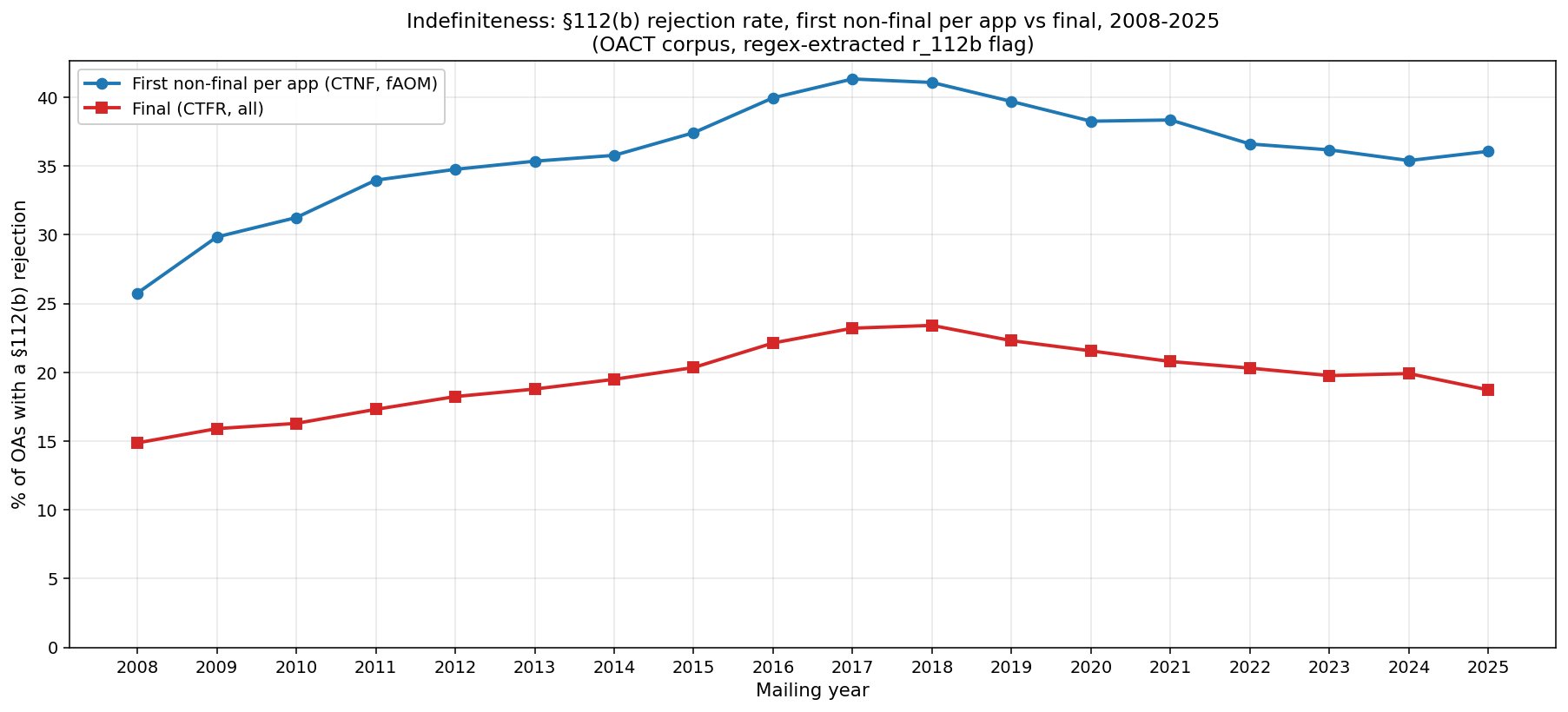
"For indefiniteness under §112(b), examiners make these more-often-than-not in the first non-final office action. For written description and enablement under §112(a), the pattern flips: final rejection rates exceed first non-final rates."
"The §112(b) gap is consistent with the standard prosecution workflow. Examiners flag indefiniteness problems on the first office action. Applicants then amend claims to tighten-up the scope, and many of those problems are resolved before the application reaches a final rejection. Indefiniteness is, in this sense, often a "drafting fixable" defect."
"This is not absolutely true since applicants might add new problems through amendment, or examiners might notice the problem later in time."
"Written description and enablement problems often surface after the applicant amends, particularly when amendments push claim language beyond what the original specification actually supports. So even though the disclosure is fixed at filing, the rejections accumulate as prosecution narrows or shifts the claims. Many of the initial rejections for 112(a) involve continuation cases or PCT cases with preliminary amendments."
Indefiniteness under §112(b) appears more frequently in the first non-final office action. Written description and enablement under §112(a) show the opposite pattern, with final rejection rates exceeding first non-final rates. The §112(b) pattern aligns with prosecution workflow: examiners identify indefiniteness early, applicants amend claims to narrow and clarify scope, and many issues are resolved before final rejection. Indefiniteness can still persist or new issues can arise from amendments or later examiner review. The §112(a) inversion reflects claim-support dynamics: written description and enablement problems often emerge after amendments, especially when amended claim language goes beyond what the original specification supports. Rejections can accumulate as prosecution narrows or shifts claims, including in continuation and PCT cases with preliminary amendments.
Read at Patently-O
Unable to calculate read time
Collection
[
|
...
]