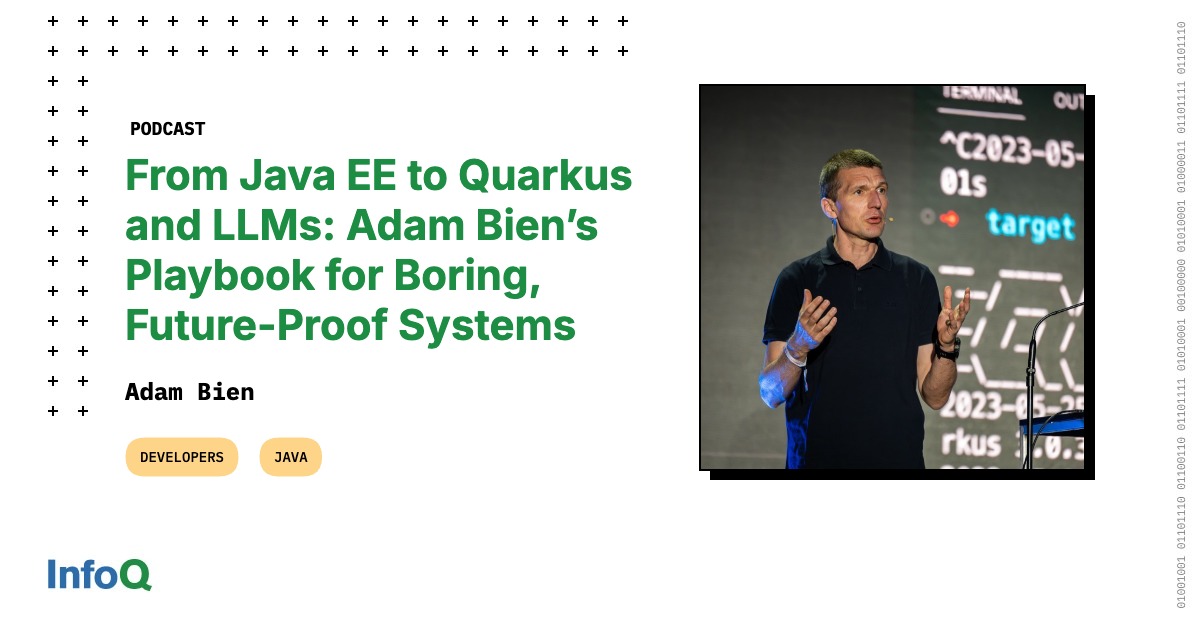
"Here you said the veteran. The truth is, in my first projects, I got the criticism that it is impossible to be dead young and an architect. So if someone calls me a senior or a veteran, and this is not true, I'm still a junior. Age is just a number, and I'm 30. So I've been a freelancer since 1997."
"Since then, I've been speaking at conferences, but I'm not considering myself as a speaker. I actually have no strategy. If I'm invited to a conference, what you will hear me speaking about is what I do in projects, so I don't have to prepare a lot. This is about me. And I spend all the time on Java, and I'm coding more than ever with Java right now."
"And do you know James, Java Apache Mail Enterprise Server? You remember something like this? I ran James on my server for mailing because I owned a new Java back then. So I used my own May server, and it was James, Java. It was Postfix and something else, and I couldn't understand how they are operating. So I use Java. And because of that, I became aware that I'm doing this, and I was asked for my first talk at a conference."
Java development continues to be driven by hands-on coding and long-term experience. A focus on practical work and real project needs shapes what is shared publicly. The view emphasizes that standards can outlast short-lived frameworks and that engineering value comes from understanding how systems operate. AI may support Java work, but it does not remove the need for expertise, design decisions, and understanding of runtime behavior. The ongoing commitment to Java includes exploring tooling and infrastructure, including early experience with Java-based mail and server components. The overall direction favors adaptability while maintaining grounding in proven approaches.
Read at InfoQ
Unable to calculate read time
Collection
[
|
...
]