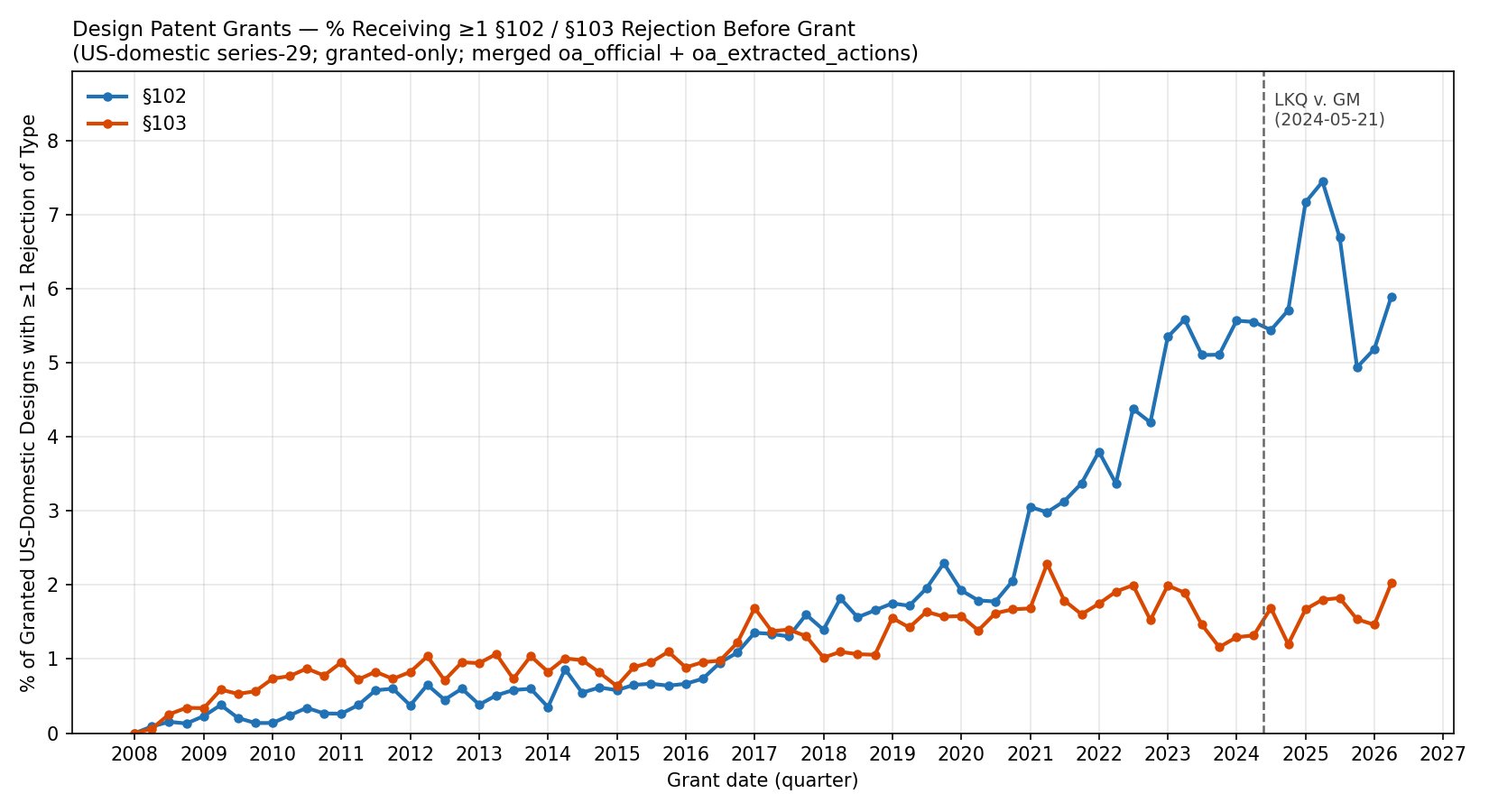
"Design patent prosecution has changed substantially over the past decade. One place we see that is in the anticipation rejection rate. Among US-domestic design patents that actually issued, the share that received at least one §102 rejection during prosecution climbed from roughly 0.1% in 2008 to above 7% in early 2025. The rate has pulled back slightly under Director Squires to around 5-6%, but even at that level it sits at the highest sustained figure ever recorded."
"The chart here shows the percentage of granted U.S. design patents that received at least one §102 or §103 rejection during prosecution, grouped by grant date. Granted patents only; abandoned applications are not reflected because the bulk of design patents (the U.S. originated ones) are kept secret and never published."
"In a prior post, I looked at U.S. design patent applications that came through the Hague System (series-35); and the data here for series-29 applications is roughly the same for obviousness rejections - showing no post-LKQ rise. Dennis Crouch, Prior Art Rejection Rates in Design Patent Prosecution, Patently-O (May 2026). But, the domestic cases show a much higher rate of §102 anticipation rejections than what I found in Hague cases."
"Most of the rise in anticipation rejections has come from searches of US-facing marketplace platforms - Amazon.com in particular. Those searches return results that reflect products already in the US consumer market. Domestic applicants are more likely to have their products listed on Amazon before or around the time of filing. Hague applicants skew heavily foreign, and foreign-originated goods may not yet have a"
Design patent prosecution has shifted over the past decade, with a major increase in anticipation rejection rates. Among U.S.-domestic design patents that issued, the proportion receiving at least one §102 rejection during prosecution rose from roughly 0.1% in 2008 to above 7% in early 2025. The rate later pulled back under Director Squires to around 5–6%, which remains the highest sustained level recorded. The data tracks only granted U.S. design patents, excluding abandoned applications because most U.S.-originated design applications remain secret. Hague-system cases show no post-LKQ rise for obviousness rejections, while domestic cases show much higher §102 rates. The increase is attributed to prior-art searches of U.S. marketplace platforms, especially Amazon.com, where domestic applicants’ products are more likely to be listed before or around filing.
Read at Patently-O
Unable to calculate read time
Collection
[
|
...
]