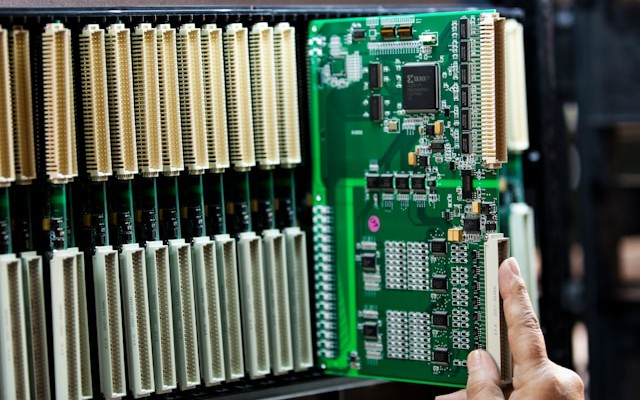
"Retail point-of-sale systems today offer a wide range of options for peripherals and hardware. Their technical specifications play a major role in selection, and big retailers often choose multiple vendors to reduce a single point of failure. This gives them an advantage to negotiate price or support as well. Technically, these peripherals also require updating with new models and may have new feature sets. This necessitates the redevelopment of point-of-sale applications, increasing development costs."
"Another problem with managing hardware interactions is that rapid scanning would generate a burst of requests, and we need a mechanism to handle them all. Failure to do so would result in lost messages, eventually causing poor customer experience or loss to retailers as they would sell items not scanned properly. Security is also an important aspect. We want messages through a secure channel to ensure that when we are handling payment card data, we do it securely. Otherwise, we would not meet PCI compliance rules for the payment industry."
"To mitigate this challenge, we adapted programming to an interface model and added a layer for transformations. This approach gave us a seamless transition when using new hardware and its libraries. It encapsulates the application's complexity and ensures interoperability. Key components of this architecture are: Application: This is a point-of-sale application that encapsulates all business logic and interactions with backend APIs hosted in the cloud or on an in-house server. Listeners/Emitters: This is code packaged as a library that securely exchanges messages from the message bus. Message Bus: A queue library like Apache MQ, which stores messages temporarily until they are read."
An interface model and transformation layer decouple point-of-sale applications from peripheral hardware and vendor libraries, enabling seamless integration of new devices. Packaged listeners and emitters exchange messages securely with a message bus such as Apache MQ to buffer bursts from rapid scanning and prevent lost messages. WebSocket Secure provides a real-time bidirectional channel between peripherals and listeners. The application encapsulates business logic and backend API interactions. Multiple vendors reduce single-point failures and support negotiation on price and support. Secure channels and proper handling of payment card data support PCI compliance.
Read at dzone.com
Unable to calculate read time
Collection
[
|
...
]