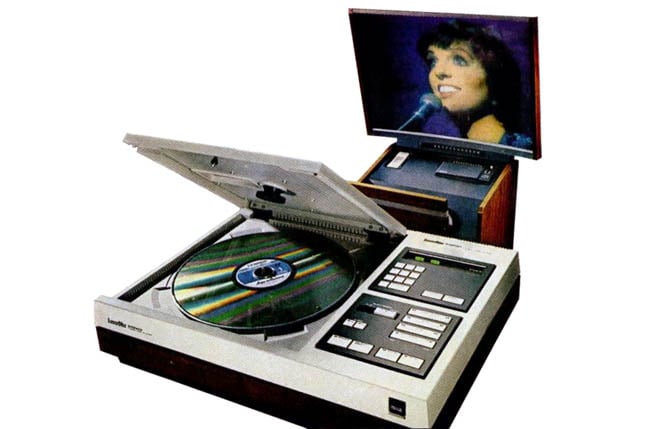
"LaserDiscs are an analog media, the data is encoded in the time between pits on an aluminum layer of the disc. This has a weak diffraction effect but it can still be seen. The ideal subject to look for on a disc to visibly see recognizable subjects is a vertically panning image."
"A video signal (typically composite) is encoded on the disc via a pattern of pits. A LaserDisc player reads these and reconstructs the original signal. As long as the speed of the vertical scroll is within a specific range, you will be able to see legible text in the same way that a slit scan camera works."
Tech enthusiast Shelby Jueden demonstrated that a digital microscope can view media stored on LaserDiscs by examining the physical pit patterns on the disc's aluminum layer. LaserDiscs encode video data analogically through pit spacing, creating a weak diffraction effect visible under magnification. Unlike CDs, which use digital encoding and produce unrecognizable results, LaserDiscs reveal identifiable content. Vertically panning images and scrolling graphics work best for visualization, functioning similarly to slit scan cameras. Jueden successfully identified film credits from True Grit with surprising clarity using this technique, proving that analog storage methods leave readable traces at the microscopic level.
#laserdisc-technology #analog-media-visualization #digital-microscopy #retro-technology #optical-media-analysis
Read at Theregister
Unable to calculate read time
Collection
[
|
...
]