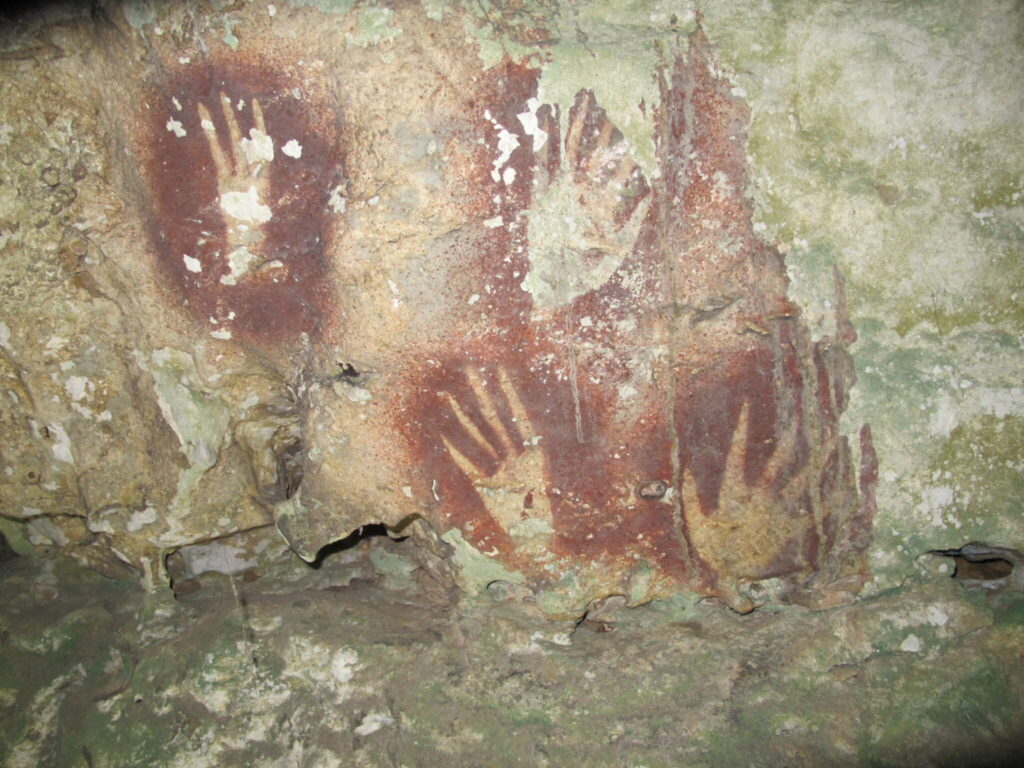
Liang Metanduno cave on Muna Island, Southeast Sulawesi, contains many paintings of humans, animals, and boats and served as a major art site until about 20,000 years ago. A faint handprint there was probably created by blowing an ochre-and-water mixture over an actual human hand. Uranium-series analysis of calcium-carbonate deposits on and around the print produced a minimum age of 67,800 years. That minimum age exceeds the oldest similar Indonesian rock art and a hand stencil in Spain attributed to Neanderthals. The handprint's true age may be older than the minimum, and the maker could possibly have been Neanderthal.
"Image by Ahdi Agus Okta­viana Over the cen­turies, a vari­ety of places have laid cred­i­ble claim to being the world's art cen­ter: Con­stan­tino­ple, Flo­rence, Paris, New York. But on the scale of, say, ten mil­len­nia, the hot spots become rather less rec­og­niz­able. Up until about 20,000 years ago, it seems that cre­ators and view­ers of art alike spent a good deal in one par­tic­u­lar cave: Liang Metan­duno, locat­ed on Muna Island in Indone­sia's South­east Sulawe­si province. The many paint­ings on its walls of rec­og­niz­able humans, ani­mals, and boats have brought it fame in our times as a kind of ancient art gallery. But in recent years, a much old­er piece of work has been dis­cov­ered there, one whose cre­ation occurred at least 67,800 years ago."
"The cre­ation in ques­tion is a hand­print, faint but detectable, prob­a­bly made by blow­ing a mix­ture of ochre and water over an actu­al human hand. To deter­mine its age, researchers per­formed what's called ura­ni­um-series analy­sis on the deposits of cal­ci­um car­bon­ate that had built up on and around it."
"The num­ber of 67,800 years is, of course, not exact, but it's also just a min­i­mum: in fact, the hand­print could well be much old­er. In a paper pub­lished last week in Nature, the researchers point out that its age exceeds both that of the old­est sim­i­lar rock art found else­where in Indone­sia and that of a hand sten­cil in Spain attrib­uted to Nean­derthals, "which until now rep­re­sent­ed the old­est demon­strat­ed min­i­mum-age con­straint for cave art world­wide.""
Read at Open Culture
Unable to calculate read time
Collection
[
|
...
]