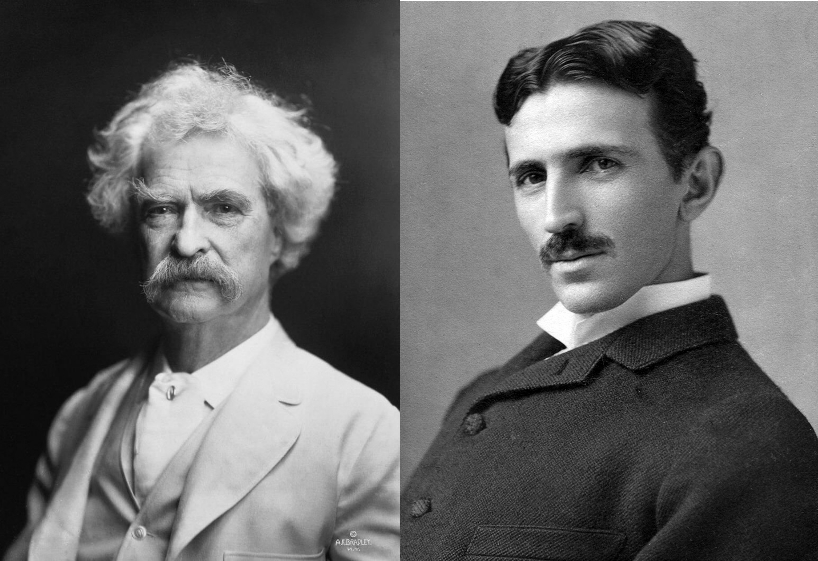
"Mark Twain was, in the esti­ma­tion of many, the Unit­ed States of Amer­i­ca's first tru­ly home­grown man of let­ters. And in keep­ing with what would be rec­og­nized as the can-do Amer­i­can spir­it, he could­n't resist putting him­self forth now and again as a man of sci­ence - or, more prac­ti­cal­ly, a man of tech­nol­o­gy. Here on Open Cul­ture, we've pre­vi­ous­ly fea­tured his patent­ed inven­tions (includ­ing a bet­ter bra strap), the type­writer of which he made pio­neer­ing use to write a book,"
"As it hap­pens, Tes­la had become a fan of Twain's long before they met, hav­ing found solace in the Amer­i­can writer's books pro­vid­ed dur­ing a long, near-fatal stretch of child­hood ill­ness. He cred­its his recov­ery with the laugh­ter that read­ing mate­r­i­al pro­vid­ed him, and one imag­ines see­ing life in the U.S. through Twain's eyes played some part in his even­tu­al emi­gra­tion there."
"By that point, Twain him­self was liv­ing in Europe, though his fre­quent vis­its to New York meant that he could drop by Tes­la's lab and see how his lat­est exper­i­ments with elec­tric­i­ty were going. It was there, in 1894, that the two men took the pho­to­graph above, in which Twain holds a vac­u­um lamp engi­neered by Tes­la and pow­ered (out of frame) by the elec­tro­mag­net­ic coil that bears his name."
Mark Twain earned a reputation as the United States' first homegrown man of letters and often presented himself as a man of science and technology. He patented inventions, experimented with a typewriter to produce books, and wrote speculative fiction that anticipated later networks. Nikola Tesla admired Twain from childhood and credited Twain's books and humor with aiding recovery from a serious illness and shaping views that influenced emigration. Twain visited Tesla's New York laboratory, and in 1894 posed holding a vacuum lamp engineered by Tesla and powered by Tesla's electromagnetic coil.
Read at Open Culture
Unable to calculate read time
Collection
[
|
...
]