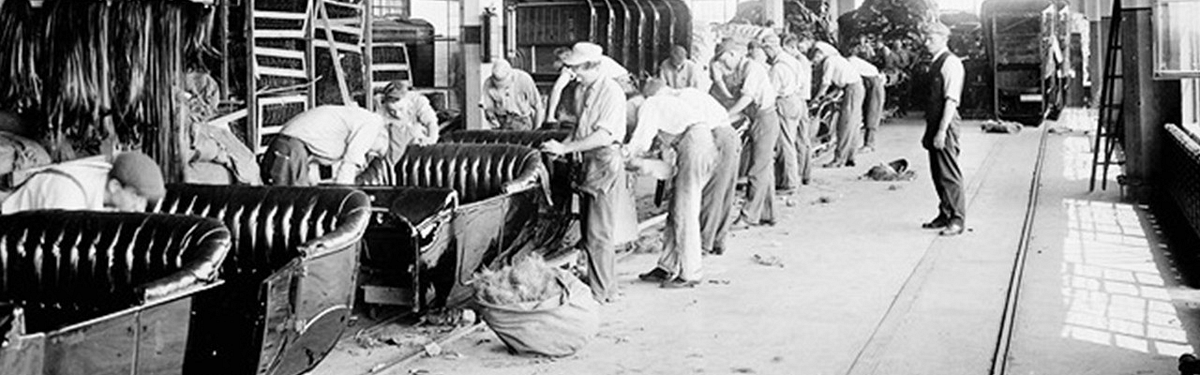
The Industrial Revolution transformed production methods, work organization, and societal roles. Eli Whitney's introduction of interchangeable parts revolutionized manufacturing, allowing ordinary workers to assemble complex products. Ransom Olds further advanced this with the stationary assembly line in automotive production. Henry Ford innovated by introducing the moving assembly line, drastically reducing assembly time and redefining the social contract with workers. The current Intelligence Revolution parallels these changes, requiring leaders to understand history to navigate the evolving landscape of work and production.
"Eli Whitney's insight was that standardized parts meant ordinary workers could assemble complex products without being master craftsmen by following a simple set of steps."
"In 1913, Ford introduced the moving assembly line at his Highland Park plant, and the results were staggering almost immediately."
"Ford's genius wasn't just mechanical engineering, it was understanding that productivity could be enhanced by changing the roles of workers in the assembly process."
Read at Medium
Unable to calculate read time
Collection
[
|
...
]