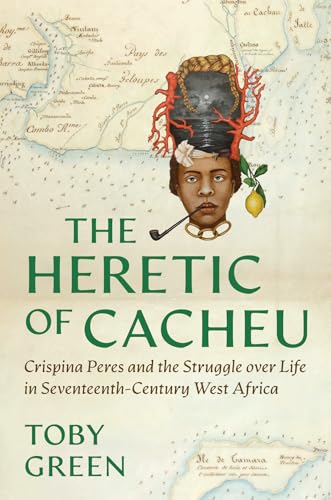
"Cacheu, located in present-day Guinea-Bissau, was a small but vital Atlantic port where African, European, and Afro-Portuguese communities interacted daily. It functioned as a hub linking West Africa to Brazil and the wider Atlantic world. Rather than presenting Cacheu as a peripheral outpost of European expansion, Green shows it to be a dynamic society with its own social hierarchies, customs, and systems of authority."
"Crispina Peres was a wealthy trader involved in the commerce of enslaved people, a fact that the book confronts directly without moral evasion. She was also a Christian who attended church and participated in Catholic rituals while simultaneously drawing on African healing practices and spiritual traditions."
"In The Heretic of Cacheu, Toby Green uses one extraordinary life to illuminate a broader historical landscape shaped by commerce, belief, gender, and cultural negotiation."
Toby Green's biography examines Crispina Peres, a powerful African trader prosecuted by the Portuguese Inquisition in the 1660s at Cacheu, a vital Atlantic port in present-day Guinea-Bissau. Rather than portraying Cacheu as a peripheral European outpost, Green demonstrates it as a dynamic society with distinct hierarchies and authority systems where African, European, and Afro-Portuguese communities interacted daily. Peres emerges as a central community figure who engaged in enslaved people commerce while practicing Christianity through Catholic rituals and African healing traditions simultaneously. The work contributes to world history emphasizing global connections and reveals the moral tensions, everyday realities, and interconnections characterizing early modern West Africa.
#early-modern-west-africa #portuguese-inquisition #atlantic-world-trade #gender-and-religion #cultural-syncretism
Read at World History Encyclopedia
Unable to calculate read time
Collection
[
|
...
]