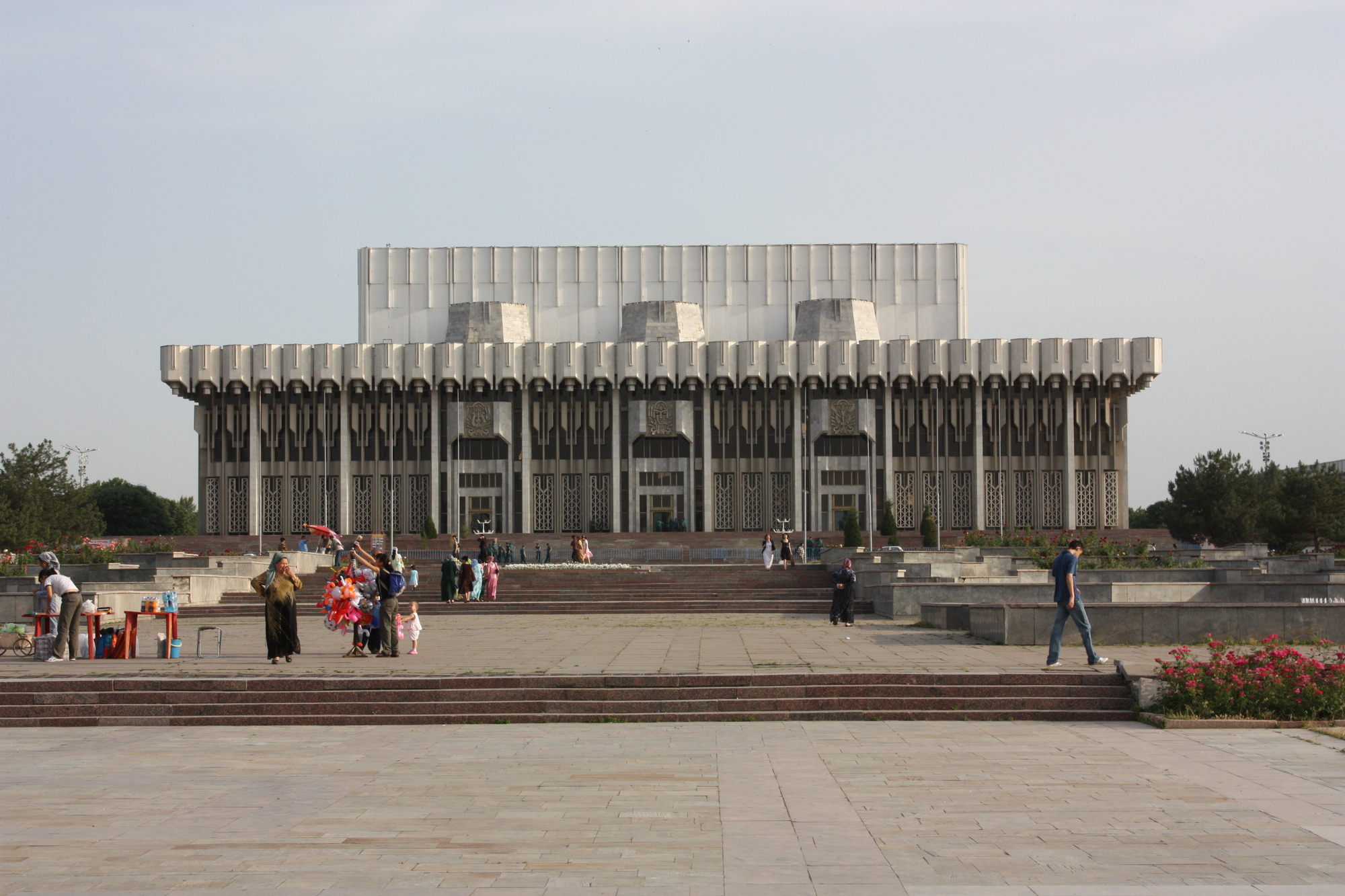
"Tashkent, the capital of Uzbekistan and one of the oldest cities in Central Asia, has long been shaped by a hybrid culture. Located at a strategic point along the Silk Road, the city developed an architectural tradition defined by inner courtyards, domes, decorative ceramics, and Islamic geometric patterns. The annexation by the Russian Empire in the 19th century introduced administrative buildings, orthogonal squares, and straight avenues,"
"During the Soviet period, when Tashkent became the capital of the Uzbek Soviet Socialist Republic and received intense migration from across the union, the city was transformed into a modernist showcase. The coexistence between Islamic heritage and the ideology of socialist progress found a new inflection point with the 1966 earthquake, whose destruction triggered a large-scale reconstruction effort involving architects from across the USSR."
Tashkent developed as a hybrid city at a strategic Silk Road node, combining Islamic architectural elements such as inner courtyards, domes, decorative ceramics, and geometric patterns with later European urban forms. Nineteenth-century Russian annexation added administrative buildings, orthogonal squares, and straight avenues, producing a dual urban fabric where Eastern and European quarters contrasted and overlapped. Soviet-era designation as the Uzbek SSR capital and widespread migration transformed the city into a modernist showcase. The 1966 earthquake prompted large-scale reconstruction by architects from across the USSR, resulting in housing complexes, cultural institutions, and monumental buildings that reinterpreted local motifs through ideological and technological frameworks.
Read at ArchDaily
Unable to calculate read time
Collection
[
|
...
]