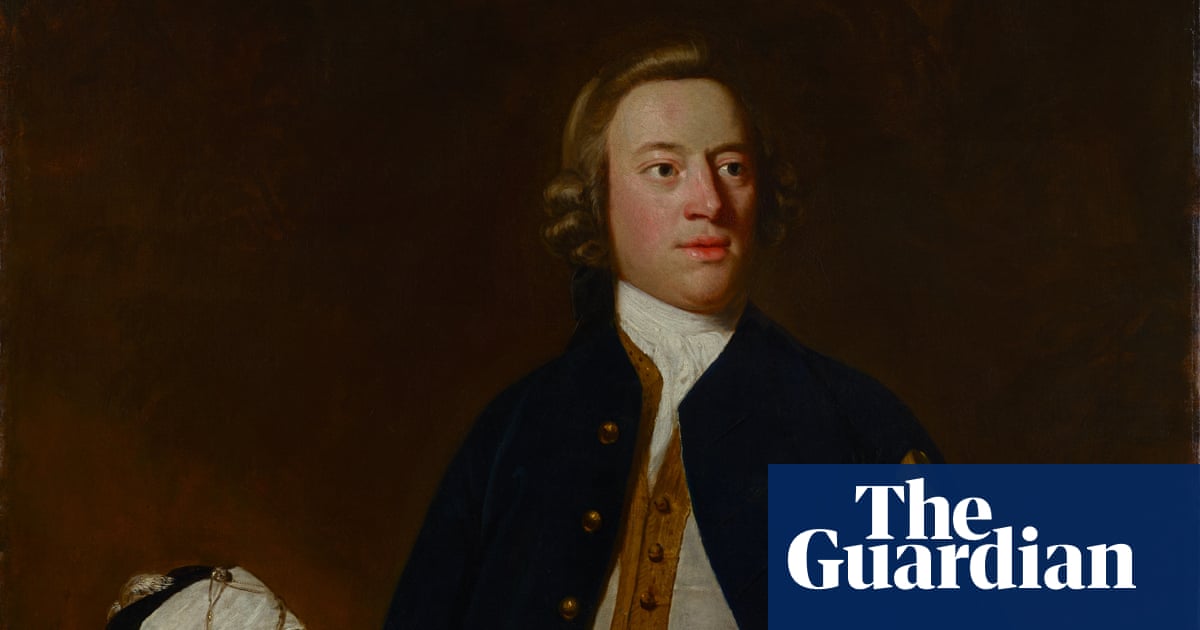
"For hundreds of years, he was known only as Jersey, an enslaved boy of about 11 rendered in oil on canvas by the great 18th-century portrait painter Sir Joshua Reynolds. But now the life of the youngster, believed to be Reynolds' earliest depiction of a person of colour, has begun to emerge, thanks to a research project. Details found in admiralty records and other archives have unearthed information about Jersey's identity, his military service and even hint he may eventually have found freedom."
"The painting, thought to have been completed around 1748, shows the boy and his master, the naval officer and MP Paul Henry Ourry. While Ourry looks out into the distance authoritatively, the enslaved child gazes up at the officer tentatively. It was hung in the saloon at Saltram, a National Trust Georgian mansion, in Plympton, Devon, its title: Lieutenant, later Captain, Paul Henry Ourry, MP (1719-1783) with an enslaved child known as Jersey (dates unknown)."
"Old layers of varnish and non-original paint were removed and reversible inpainting' techniques used to fill in missing or damaged areas of the painting, while preserving the original materials and intent. Photograph: Sarah Maisey/National Trust Mark Brayshay, a volunteer researcher at Saltram, said: A key motivation for our research was to explore whether more could be discovered about Jersey than merely his supposed name. Could we acknowledge and honour him as a distinct individual?"
"Scouring admiralty records, letters, muster books (ships' registers) and captains' logs, Brayshay and Katherine Gazzard, a curator at Royal "
An enslaved boy known as Jersey, painted by Sir Joshua Reynolds around 1748, is shown with naval officer and MP Paul Henry Ourry. The portrait was long understood mainly through Ourry’s life, while Jersey’s identity and experiences were largely unknown. A research project combined archival investigation with painting conservation to recover missing information. Admiralty records, letters, muster books, and captains’ logs were used to identify Jersey, trace his military service, and suggest he may have later gained freedom. Conservation work removed old varnish and non-original paint and used reversible inpainting to preserve original materials while restoring damaged areas. The project aims to recognize Jersey as a distinct individual with a recoverable personal story.
#reynolds-portraiture #enslavement-history #archival-research #art-conservation #british-naval-records
Read at www.theguardian.com
Unable to calculate read time
Collection
[
|
...
]