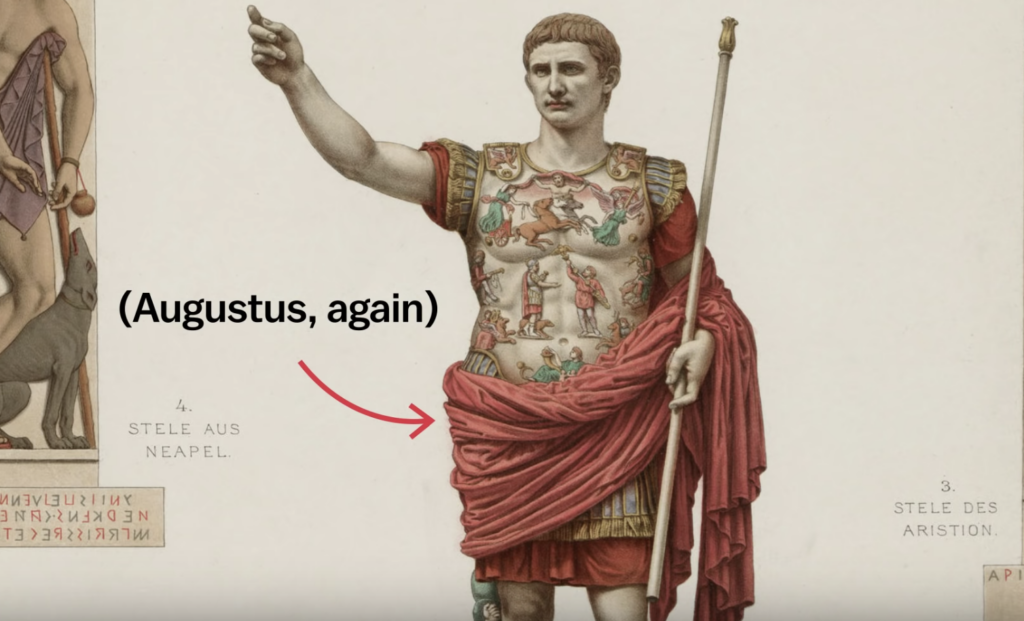
"One tenet of classical idealism is the idea that Roman and Greek statuary embodied an ideal of pure whiteness-a misconception modern sculptors perpetuated for hundreds of years by making busts and statues in polished white marble. But the truth is that both Greek statues and their Roman counterparts were originally brightly painted in riotous color."
"This includes the 1st century A.D. Augustus of Prima Porta, the famous figure of the Emperor standing triumphantly with one hand raised. Rather than left as blank white marble, the statue would have had bronzed skin, brown hair, and a fire-engine red toga. Ancient Greece and Rome were really colorful."
"It's partly an honest mistake. After the fall of Rome, ancient sculptures were buried or left out in the open air for hundreds of years. By the time the Renaissance began in the 1300s, their paint had faded away."
The perception of classical antiquity as an elegantly unified collection of superior aesthetic and philosophical traits developed largely during the Neoclassical era. A widespread misconception about classical sculpture is that Greek and Roman statuary embodied an ideal of pure whiteness. However, both Greek statues and their Roman counterparts were originally painted in bright, vibrant colors. The famous Augustus of Prima Porta statue, for example, featured bronzed skin, brown hair, and a fire-engine red toga rather than blank white marble. This misunderstanding arose partly because ancient sculptures were buried or exposed to the elements for centuries after Rome's fall. By the Renaissance in the 1300s, the original paint had faded completely, leading artists and scholars to assume the statues were always white.
#classical-sculpture #ancient-greece-and-rome #misconceptions-about-antiquity #renaissance-art-history #polychrome-statuary
Read at Open Culture
Unable to calculate read time
Collection
[
|
...
]