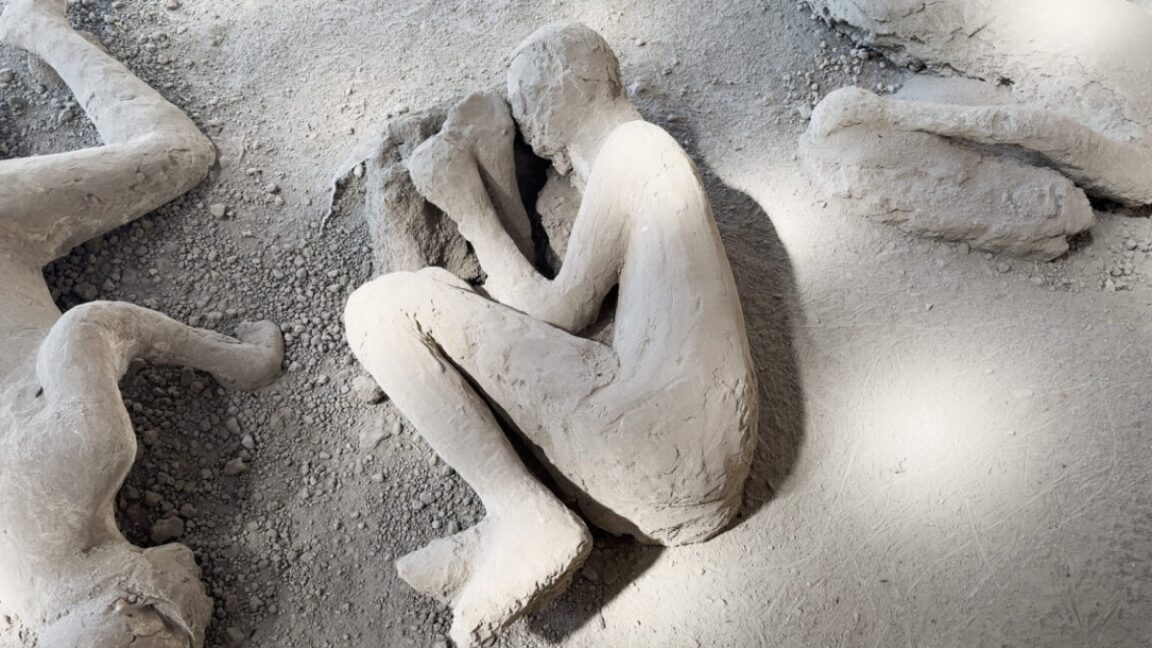
Archaeologists used CT scans and 3D digital reconstruction to identify a Pompeii victim who died in 79 CE during the eruption of Mount Vesuvius as most likely a Roman doctor. The eruption released extreme thermal energy, spreading molten rock, pumice, and hot ash over Pompeii and Herculaneum. Most victims likely died from asphyxiation caused by noxious gas and ash, while some may have died instantly from intense heat of fast-moving lava flows. Giuseppe Fiorelli developed plaster casts by filling voids left by soft tissue. About 1,000 bodies were found, with 104 casts preserved, and restoration of 86 casts used CT scans and X-rays to assess skeleton completeness. Imaging showed frequent manipulation of casts, including altered body shapes, added metal rods, and removal of bones. Ancient DNA from four victims in the House of the golden bracelet found all were male and unrelated, challenging earlier narratives tied to cultural biases.
"Archaeologists used a combination of advanced CT scans and 3D digital reconstruction to identify one of the Pompeii victims who died in 79 CE during the eruption of Mount Vesuvius as most likely having been a Roman doctor, according to an announcement by the Pompeii Archaeological Park."
"The vast majority of people in Pompeii and Herculaneum-the cities hardest hit-perished from asphyxiation, choking on the thick clouds of noxious gas and ash. But at least some of the Vesuvian victims probably died instantaneously from the intense heat of fast-moving lava flows, with temperatures high enough to boil brains and explode skulls."
"Restoration efforts on 86 of those casts began about 10 years ago, during which researchers took CT scans and X-rays to determine whether complete skeletons were present. The CT scans and X-ray images revealed that there had been a great deal of manipulation of the casts, depending on the aesthetics of the era in which they were made, including altering some features of the bodies' shapes or adding metal rods to stabilize the cast, as well as frequently removing bones before casting."
"Ancient DNA analysis in 2024 of four victims found in what is known as the "House of the golden bracelet" revealed that all four bodies were male and none were genetically related-challenging the pre-existing preferred narratives and suggesting those may reflect certain cultural biases."
Read at Ars Technica
Unable to calculate read time
Collection
[
|
...
]