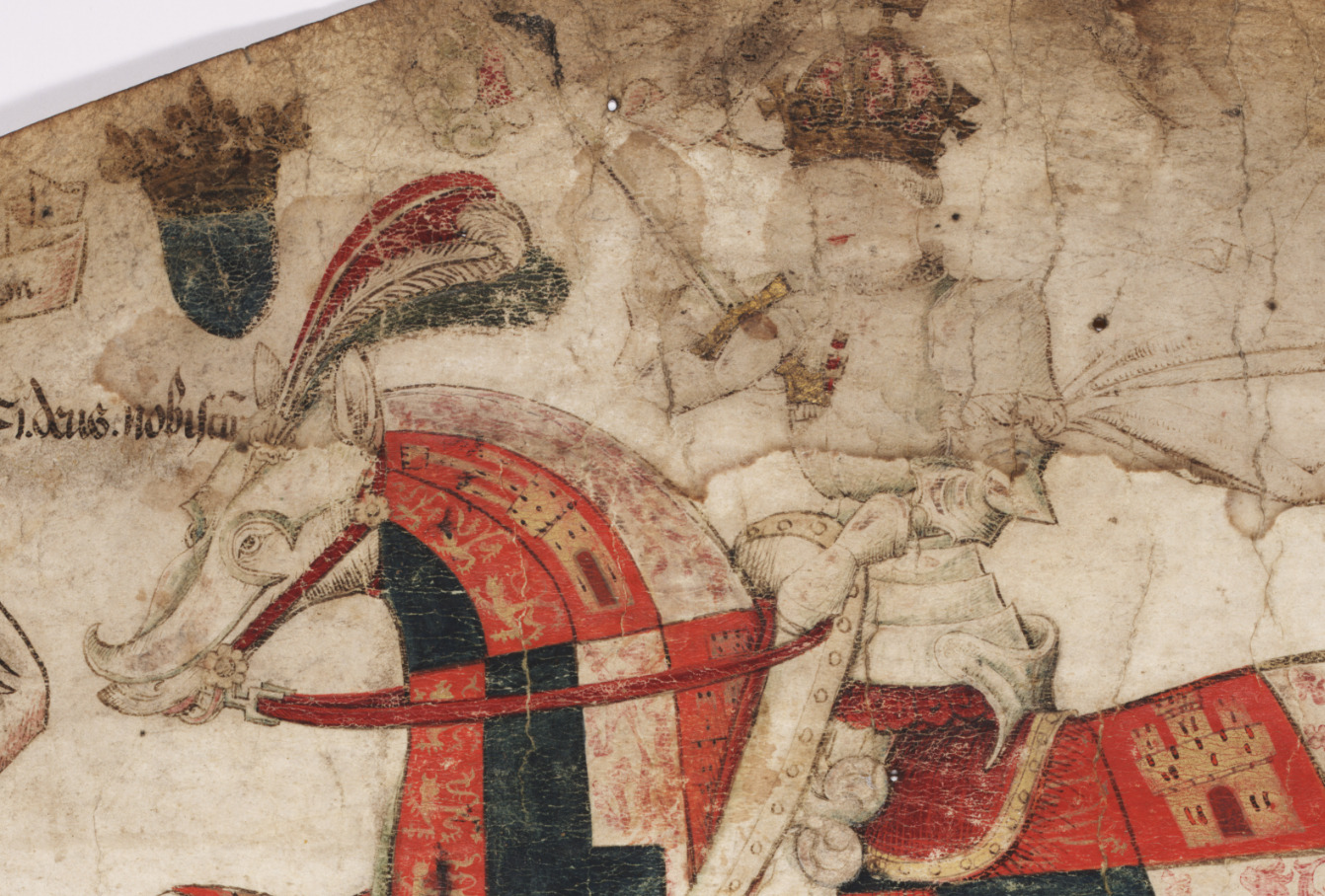
"A colourful and fiercely partisan medieval genealogy created to support Edward IV's claim to the English throne has now been digitised and made freely available online. In the turbulent fifteenth century, claimants often used elaborate genealogical rolls to legitimise their lineage, and the Free Library of Philadelphia's Manuscript Lewis E 201 is one of the most striking examples. The newly launched digital edition presents the manuscript through high-resolution images, transcriptions, translations, and extensive annotations."
"The Free Library's Manuscript Lewis E 201 was acquired by Philadelphia attorney John F. Lewis in 1927 and donated to the library by his widow in 1936. Unique among the dozens of propaganda genealogies produced in this period, it displays multiple colour-coded lines of descent reaching back to Adam and Eve and more than 50 heraldic shields and banners. "This is one of the crown jewels of the special collections in our library," says Janine Pollock, head of special collections at the Free Library."
""It has been so exciting to bring together students, scholars, librarians, and other interested parties to interpret this magnificent manuscript and to make it available to a worldwide audience," explains Emily Steiner, A.M. Rosenthal Professor of English and project director. "We were grateful to have the financial and practical support of so many different partners. It was wonderful to be able to provide a research opportunity and financial support for our talented graduate students." Steiner directed a team of graduate students who transcribed, translated, and researched the sources of the manuscript."
Manuscript Lewis E 201, a colourful and partisan fifteenth-century genealogical roll supporting Edward IV, has been digitised and released as a digital edition. The digital edition includes high-resolution images, full transcriptions, translations, and extensive annotations to aid study and interpretation. The manuscript features multiple colour-coded descent lines tracing back to Adam and Eve and more than fifty heraldic shields and banners. The Free Library acquired the manuscript in 1927 and it was donated in 1936. A team of graduate students transcribed, translated, and researched the manuscript with institutional and partner support, increasing accessibility while protecting the fragile original. The manuscript images and annotations are presented in the Digital Map
Read at Medievalists.net
Unable to calculate read time
Collection
[
|
...
]