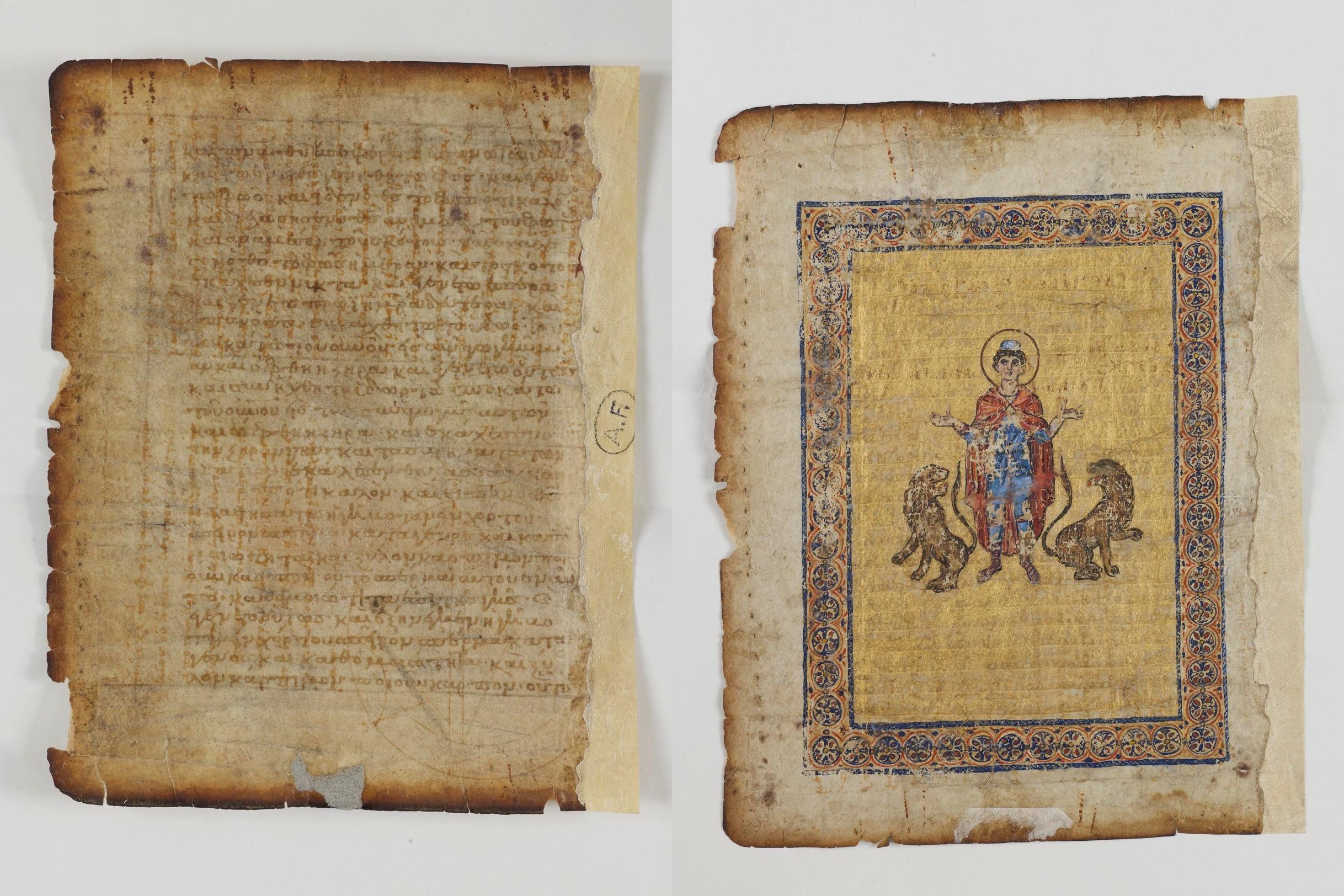
A page from the Archimedes Palimpsest, a tenth-century Greek manuscript preserving works by ancient mathematician Archimedes, has been discovered at the Musée des Beaux-Arts in Blois, France. The leaf contains portions of Archimedes' treatise On the Sphere and the Cylinder, specifically Book I, Propositions 39 to 41, with much of the mathematical text remaining legible. The palimpsest was created when medieval scribes erased original texts to reuse parchment, a common practice in medieval manuscript culture. The manuscript traveled through Jerusalem and Constantinople before being photographed by Danish scholar Johan Ludvig Heiberg in 1906. Now housed at the Walters Art Museum in Baltimore, the palimpsest has been extensively studied using multispectral imaging technology since the early 2000s, revealing previously unknown ancient texts.
"The newly identified leaf corresponds to page 123 of the Palimpsest and contains part of Archimedes' treatise On the Sphere and the Cylinder, specifically Book I, Propositions 39 to 41. Much of the mathematical text remains legible, despite later alterations to the manuscript."
"The Archimedes Palimpsest itself is a tenth-century Greek manuscript that preserves several of the mathematician's works. During the Middle Ages, however, parts of the original text were erased so that the parchment could be reused. This recycling process, known as creating a palimpsest, was common in medieval manuscript culture."
"In 1906, the Danish scholar Johan Ludvig Heiberg photographed the manuscript, creating a crucial record of its contents. These photographs would later prove essential, as the manuscript subsequently changed hands several times and some of its leaves disappeared."
#archimedes-palimpsest #ancient-greek-mathematics #medieval-manuscript-culture #manuscript-discovery #palimpsest-technology
Read at Medievalists.net
Unable to calculate read time
Collection
[
|
...
]