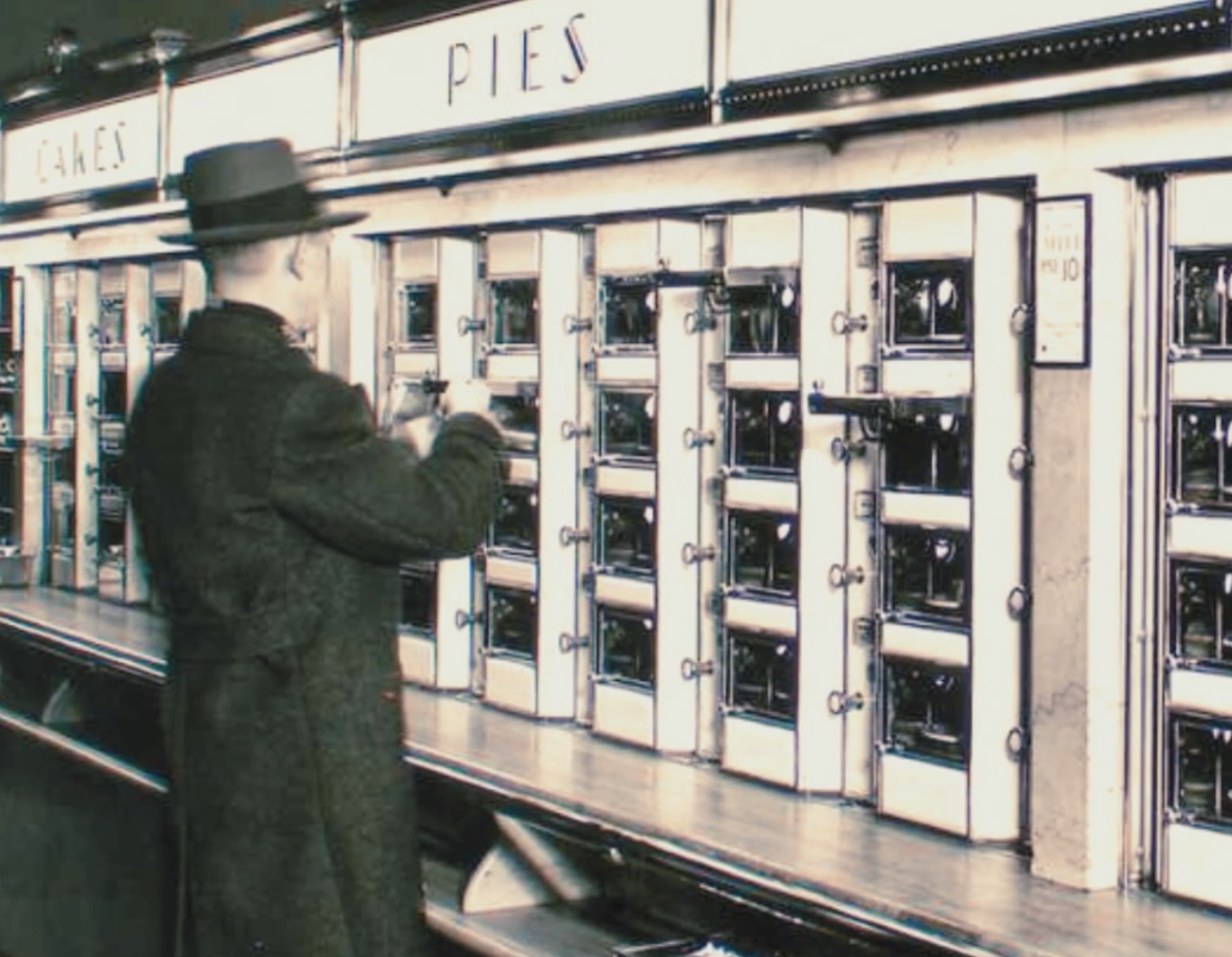
""Good evening," said Alfred Hitchcock to the television viewers of America on March 25, 1959. "Tonight I'm dining at my favorite club. There are many advantages here. As you can see, informality is the rule. There is also the stimulation of intellectual companionship without the deafening quiet that pervades most clubs. Best of all, I like its privacy: only four persons are allowed at a table, and, of course, no one pays any attention to you.""
"The concept, which co-founder Joseph Horn imported over from Berlin in the early nineteen-tens, was of a restaurant with no waiters: rather, you could choose your dish à la carte from a wall of coin-operated compartments, paying the nickel or two that would allow you to take the food inside."
"Salisbury steak, creamed spinach, baked beans, a ham-and-cheese sandwich, macaroni and cheese, chocolate pudding, strawberry rhubarb pie: whatever it was, the behind-the-scenes staff would replace it just as soon as you put the last one on your tray."
Alfred Hitchcock's 1959 television introduction humorously described an automat as an exclusive club, exemplifying the deadpan irony characteristic of his show's openings. Automats were self-service restaurants that dominated urban American life, particularly in Philadelphia and New York. Horn & Hardart, co-founded by Joseph Horn who imported the concept from Berlin in the early 1900s, became the world's largest restaurant chain. Customers selected dishes à la carte from coin-operated wall compartments, paying nickels for items like Salisbury steak, creamed spinach, baked beans, sandwiches, macaroni and cheese, and desserts. Behind-the-scenes staff continuously restocked compartments as customers made selections, creating an efficient dining experience without waiters.
#horn--hardart-automats #self-service-dining #urban-restaurant-history #coin-operated-food-service #american-culinary-culture
Read at Open Culture
Unable to calculate read time
Collection
[
|
...
]