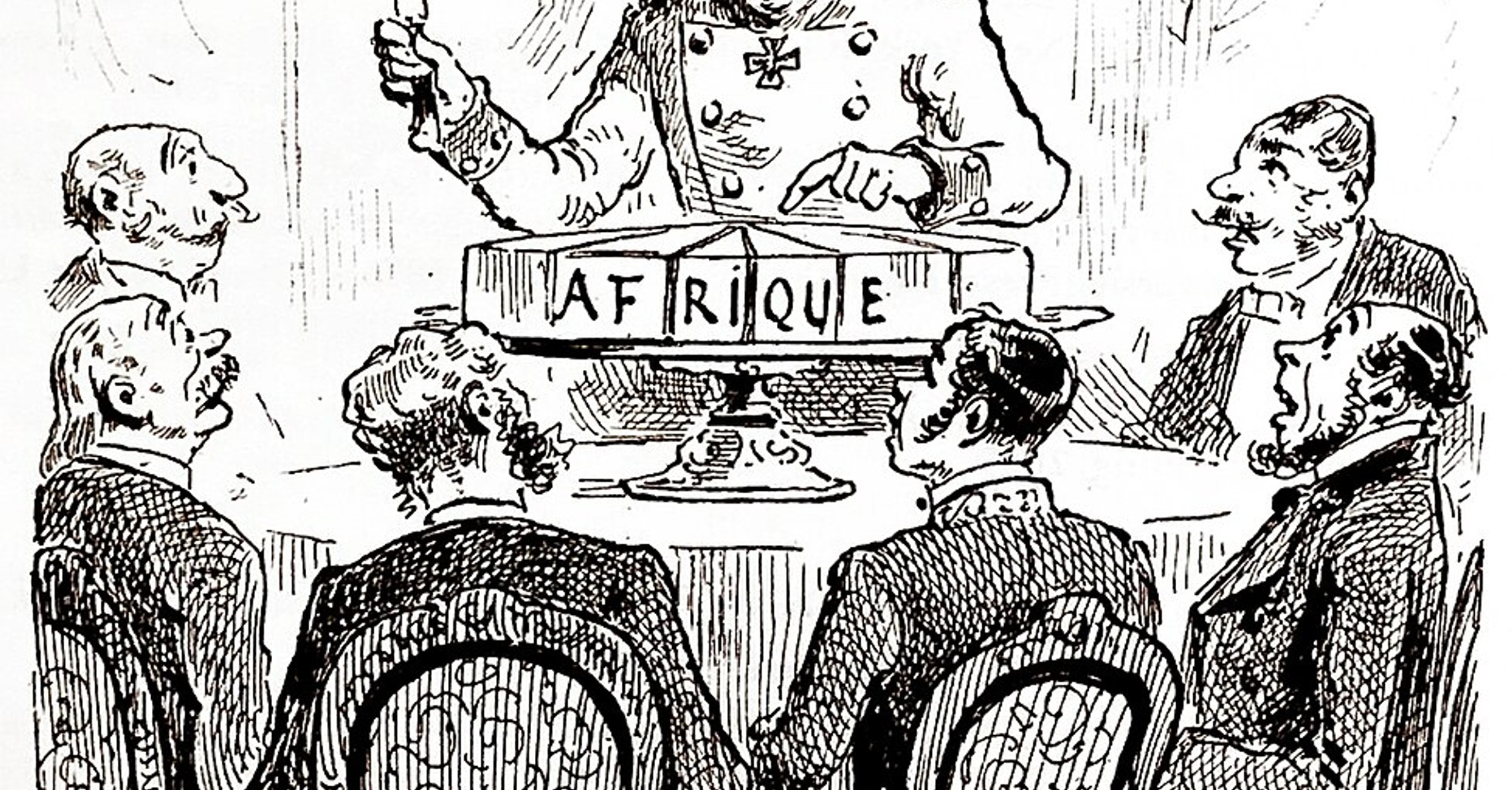
"The Berlin Conference, although it did not actually divide the continent, provided a framework by which Africa could, in the future, be partitioned into European areas of effective control and so is widely considered the beginning of a distinct acceleration in imperialist acquisitions known as the 'Scramble for Africa'."
"British ambitions in Africa were spurred on by two key events: Diamonds had been discovered at Kimberly in Southern Africa in 1867, and the explorer Henry Morton Stanley had sailed from Lake Victoria, the source of the Nile, all the way to the sea on Africa's eastern coast in 1877, showing that the continent's interior was not inaccessible thanks to its great rivers."
"Palm oil, ivory, coffee, rubber, and gold were just some of Africa's resources that European states coveted. In 1879, France sent an expedition from Senegal to claim rights along the Upper Niger and Congo - two of Africa's most important waterways - and then signed treaties with local rulers."
The Berlin Conference, held from November 1884 to February 1885, brought together major imperial powers including Great Britain, France, Belgium, and Germany to address competing territorial claims in Africa. While the conference did not directly divide the continent, it created a framework enabling future European partition and marked the beginning of accelerated imperialist expansion. European interest in Africa intensified from the late 1870s as powers sought valuable resources including diamonds, ivory, palm oil, rubber, coffee, and gold. Key developments included diamond discoveries in Kimberly in 1867 and explorer Henry Morton Stanley's 1877 journey demonstrating the continent's interior accessibility via major rivers. France and Germany subsequently competed for control of strategic waterways like the Niger and Congo, prompting the conference to establish rules for territorial acquisition.
#berlin-conference #european-imperialism #scramble-for-africa #african-colonization #imperial-competition
Read at World History Encyclopedia
Unable to calculate read time
Collection
[
|
...
]