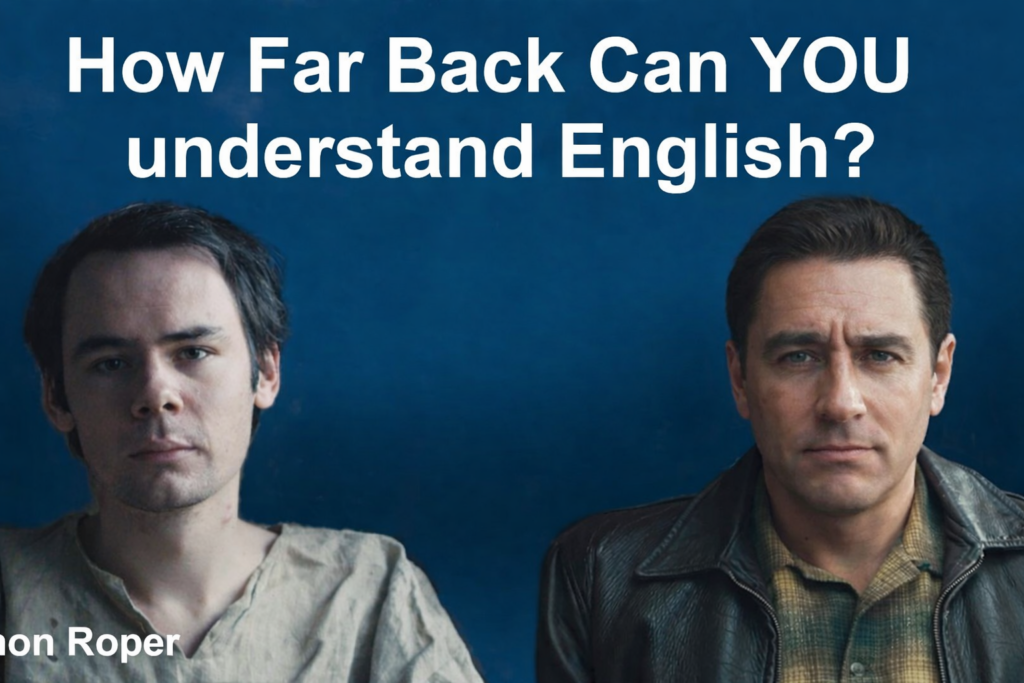
"It's easy to imag­ine the myr­i­ad dif­fi­cul­ties with which you'd be faced if you were sud­den­ly trans­port­ed a mil­len­ni­um back in time. But if you're a native (or even pro­fi­cient) Eng­lish speak­er in an Eng­lish-speak­ing part of the world, the lan­guage, at least, sure­ly would­n't be a prob­lem. Or so you'd think, until your first encounter with utter­ances like " þat troe is daed on gaerde" or "þa rokes for­leten urne tun.""
"But writ­ing and deliv­er­ing a mono­logue that works its way through a mil­len­ni­um and a half of change in the Eng­lish lan­guage is obvi­ous­ly a thornier endeav­or, not least because it involves lit­er­al thorns - the þ char­ac­ters, that is, used in the Old Eng­lish Latin alpha­bet. They're pro­nounced like th, which you can hear when Rop­er speaks the sen­tences quot­ed ear­li­er, which trans­late to "The tree is dead in the yard" and "The rooks aban­doned our town.""
A single monologue traces English from the fifth century to the end of the last millennium to illustrate massive linguistic change. The performance moves through distinct historical stages so that pronunciation, spelling, and orthography shift noticeably. Old English letters such as the thorn (þ) represent sounds that later writers render differently. Short Old English sentences translate into easily recognized modern equivalents only after explanation. The account emphasizes phonetic differences and orthographic evolution, demonstrating how familiar words can look and sound alien across centuries due to ongoing language change.
Read at Open Culture
Unable to calculate read time
Collection
[
|
...
]