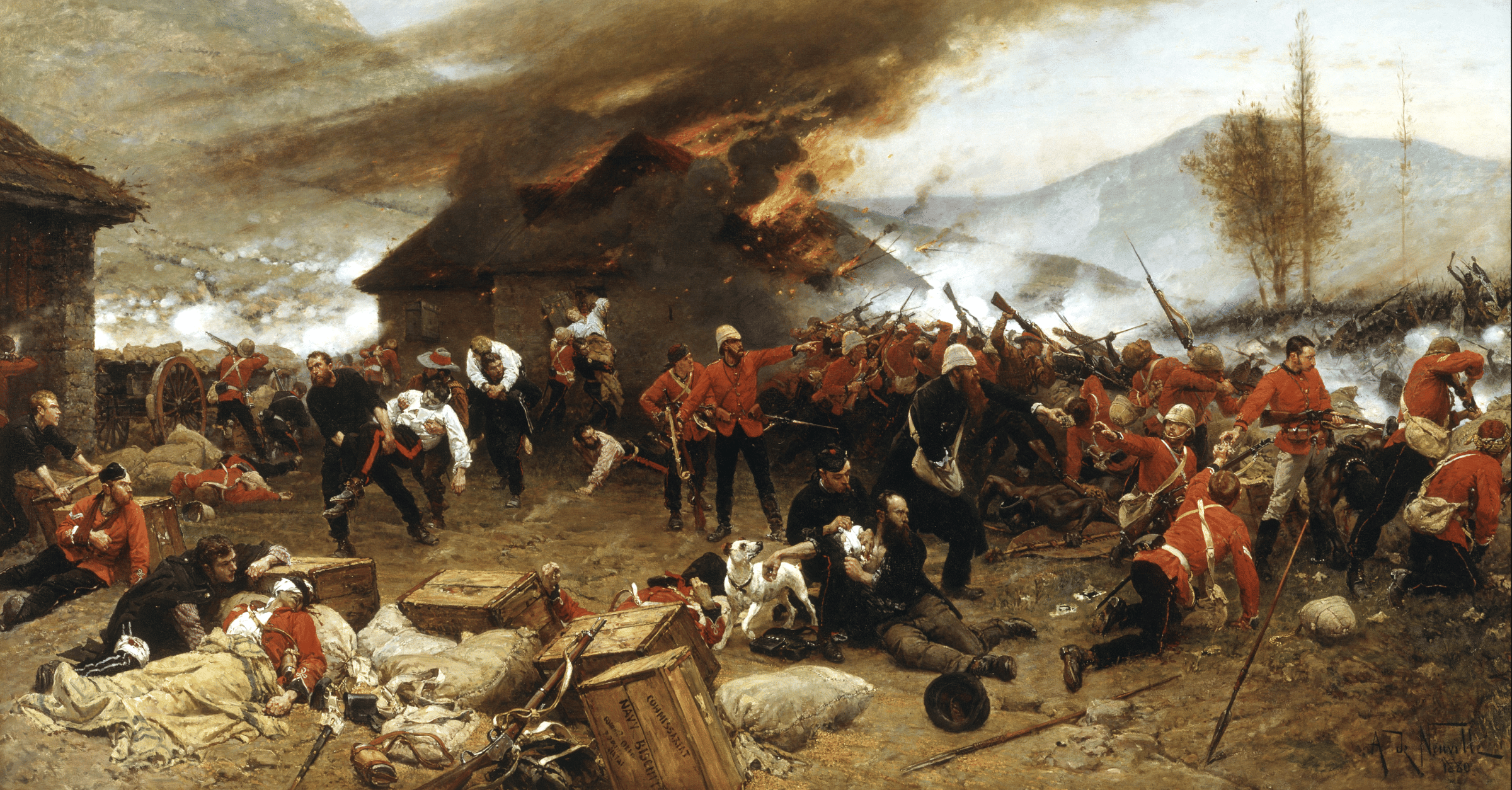
"Immediately after their famous victory over the British at the Battle of Isandlwana on 22 January 1879, as many as 4,000 Zulu warriors pushed on across the Zulu-Natal border. This Zulu army headed for Rorke's Drift, some 12 miles (19 km) away. Here was a mission station and 140 soldiers of the 24th Warwickshire Regiment and allied troops. A siege battle lasted 12 hours, but the defenders held on, all the more remarkable a feat since a good number of the men were invalids even before the battle started."
"Britain controlled the Cape Colony in Southern Africa, which was strategically important because the Cape of Good Hope was a stopping point for ships that connected India and the Far East to Europe. Through the 1830s, when the British outlawed slavery and population growth applied too much pressure to land and resources, around 14,000 Boers (White settlers of Dutch or French ancestry) migrated northwards."
"This rather poor corner of the British Empire suddenly became one of the richest when diamonds were discovered in Griqualand in the late 1860s, which was made a crown colony in 1871. The British, particularly the new Colonial Secretary Sir Michael Hicks Beach, were keen to unify the British colonies with the two Boer republics into some sort of federation."
Following their victory at Isandlwana, approximately 4,000 Zulu warriors advanced toward Rorke's Drift, a mission station garrisoned by 140 soldiers of the 24th Warwickshire Regiment and allied troops. The ensuing 12-hour siege resulted in a successful defense, remarkable given that many defenders were already invalids. Eleven Victoria Cross medals were awarded for this achievement. The Anglo-Zulu War emerged from complex colonial dynamics in Southern Africa. Britain controlled the strategically vital Cape Colony, while Boer migration northward in the 1830s created two republics: Transvaal and Orange Free State. The discovery of diamonds in Griqualand during the late 1860s transformed the region's economic importance. British colonial authorities sought to unify the colonies and republics into a federation, while African groups made desperate attempts to resist colonization.
Read at World History Encyclopedia
Unable to calculate read time
Collection
[
|
...
]